Why Dubai’s Cybersecurity Market Is Growing Rapidly: AI, Regulations, and Digital Risk
- sisgaintushar
- Jun 29
- 16 min read

Introduction
Dubai and the wider UAE have rapidly evolved into one of the Middle East’s most advanced digital economies, driven by large-scale investments in smart city infrastructure, cloud adoption, fintech, and e-government services. As digital transformation accelerates across enterprises and public sector systems, the region has simultaneously become a prime target for increasingly sophisticated cyber attacks, including ransomware, phishing campaigns, and data breaches aimed at critical infrastructure and sensitive data.
At the same time, artificial intelligence is reshaping both cyber threats and defense mechanisms, enabling faster detection but also empowering more complex attack vectors. This shift, combined with stricter cybersecurity regulations and national data protection frameworks, is pushing organizations to rethink their security posture. In this environment, cybersecurity in the UAE is no longer optional but a foundational business requirement. This article explores the key market drivers, emerging risks, and strategic opportunities shaping the UAE cybersecurity landscape.
Overview of the UAE Cybersecurity Market
The UAE cybersecurity market is evolving rapidly in response to the country’s aggressive digital transformation agenda and increasing exposure to sophisticated cyber threats. As organizations across banking, healthcare, energy, logistics, and government services migrate critical operations to cloud-based and AI-enabled systems, the demand for advanced security frameworks has intensified. Cybersecurity is now a core pillar supporting the UAE’s broader digital economy strategy, ensuring resilience, data protection, and operational continuity across sectors.
Market size and digital transformation in the UAE
The UAE’s cybersecurity market is experiencing strong growth driven by widespread adoption of cloud computing, IoT ecosystems, and AI-powered enterprise systems. Enterprises are investing heavily in endpoint security, identity management, and threat intelligence platforms to secure expanding digital infrastructures. This growth is further reinforced by the rapid digitization of SMEs and large-scale enterprises, all of which are increasing their exposure to cyber risks. As digital ecosystems expand, cybersecurity spending is becoming a strategic priority rather than a discretionary IT expense.
Role of government-led digital initiatives
Government-led initiatives play a central role in shaping the UAE’s cybersecurity landscape. National programs focused on digital governance, smart city development, and data protection frameworks are driving stricter compliance requirements for both public and private organizations. Regulatory bodies are actively promoting cybersecurity standards, incident response readiness, and critical infrastructure protection. These initiatives not only strengthen national resilience but also establish a structured environment that accelerates cybersecurity adoption across industries.
Why Dubai is emerging as a cybersecurity hub
Dubai has positioned itself as a regional cybersecurity hub due to its advanced digital infrastructure, strong regulatory ecosystem, and strategic focus on innovation. The city’s role as a global business and financial center attracts multinational corporations that require robust cybersecurity capabilities to protect sensitive data and operations. In addition, Dubai’s investment in AI, smart governance, and digital-first public services has created a high-demand environment for cybersecurity expertise. This convergence of technology adoption, regulatory maturity, and enterprise concentration is making Dubai a key driver of cybersecurity growth in the UAE.
Key Drivers Behind Cybersecurity Growth in Dubai
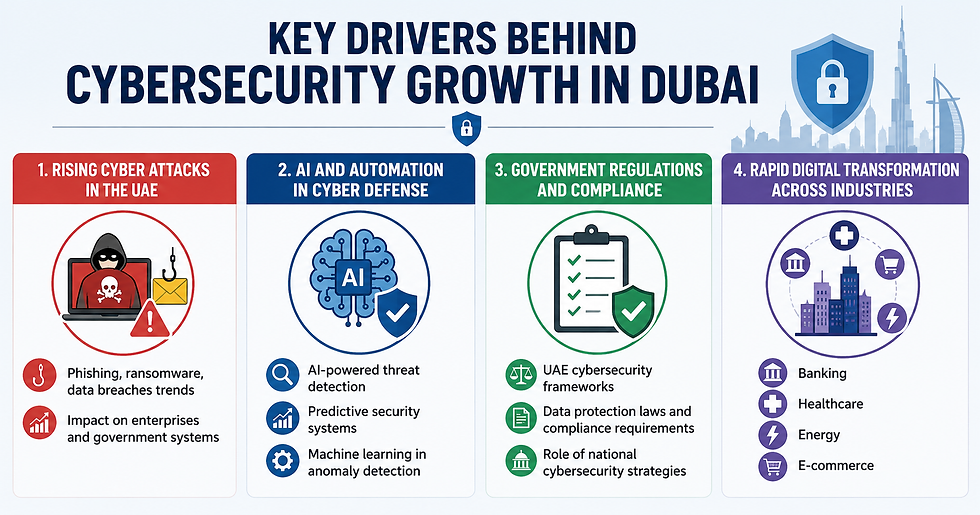
Dubai’s cybersecurity market is expanding at an unprecedented pace as businesses and government entities face an increasingly complex digital threat landscape. The combination of rising cyber attacks, rapid AI adoption, stricter regulatory requirements, and accelerated digital transformation has made cybersecurity a strategic business priority rather than a reactive IT function. Organizations across the UAE are investing in proactive security measures to protect critical infrastructure, sensitive data, and customer trust while ensuring compliance with evolving regulations.
Rising Cyber Attacks in the UAE
The frequency and sophistication of cyber attacks in the UAE have increased significantly in recent years. Cybercriminals are using advanced techniques to target organizations of all sizes, making it essential for businesses to strengthen their security posture.
Among the most common threats are:
Phishing attacks: AI-generated phishing emails and social engineering campaigns are becoming more convincing, increasing the risk of credential theft and financial fraud.
Ransomware: Attackers continue to target enterprises and public institutions by encrypting critical systems and demanding ransom payments, often causing prolonged operational disruptions.
Data breaches: Unauthorized access to confidential business and customer information can result in regulatory penalties, financial losses, and long-term reputational damage.
The impact extends beyond individual organizations. Government agencies, financial institutions, healthcare providers, and critical infrastructure operators are increasingly targeted because they manage sensitive information and essential services. As a result, organizations are shifting from traditional perimeter-based security to continuous monitoring, threat intelligence, and incident response capabilities.
AI and Automation in Cyber Defense
Artificial intelligence has become one of the most significant drivers of cybersecurity innovation in Dubai. As cyber threats evolve faster than traditional security teams can respond, AI-powered solutions help organizations detect, analyze, and mitigate attacks in real time.
Key applications include:
AI-powered threat detection: Modern security platforms analyze vast volumes of network activity to identify malicious behavior before it causes significant damage.
Predictive security systems: Advanced analytics assess historical and real-time threat data to predict potential attack patterns, enabling organizations to address vulnerabilities proactively.
Machine learning for anomaly detection: Machine learning algorithms establish normal user and network behavior, allowing security teams to quickly identify unusual activities that may indicate insider threats or compromised accounts.
By automating repetitive security tasks and accelerating threat detection, AI enables security teams to focus on strategic risk management while reducing response times to emerging cyber incidents.
Government Regulations and Compliance
The UAE government has established a strong regulatory environment to improve national cyber resilience and encourage organizations to adopt internationally recognized security standards. These frameworks require businesses to implement robust cybersecurity controls, strengthen data governance, and improve incident response capabilities.
Several factors are driving compliance investments:
National cybersecurity frameworks that promote standardized security practices across public and private sectors.
Data protection regulations requiring organizations to safeguard personal and business information through effective security controls and governance policies.
National cybersecurity strategies focused on protecting critical infrastructure, supporting digital innovation, and enhancing collaboration between government agencies and private enterprises.
For businesses operating in Dubai, regulatory compliance is no longer simply a legal obligation—it is a competitive advantage that strengthens customer confidence and reduces operational risk.
Rapid Digital Transformation Across Industries
Dubai's vision of becoming a global digital economy has accelerated technology adoption across virtually every sector. While cloud computing, artificial intelligence, Internet of Things (IoT), and digital platforms have improved operational efficiency, they have also expanded the potential attack surface for cybercriminals.
Industries driving cybersecurity demand include:
Banking and financial services: Financial institutions require advanced fraud prevention, identity management, and real-time transaction monitoring to protect customers and meet regulatory requirements.
Healthcare: Hospitals and healthcare providers must secure electronic health records, connected medical devices, and telemedicine platforms against increasingly sophisticated cyber threats.
Energy and utilities: Critical infrastructure operators rely on industrial control systems that require specialized cybersecurity measures to ensure uninterrupted operations.
E-commerce and retail: Growing volumes of online transactions and customer data have increased the need for secure payment systems, fraud detection, and customer data protection.
As organizations continue their digital transformation journeys, cybersecurity has become a foundational component of business resilience. Rather than serving as an isolated IT function, it now supports innovation, regulatory compliance, customer trust, and long-term business growth—making the UAE cybersecurity market one of the fastest-growing technology sectors in the region.
Cybersecurity Risks Facing UAE Businesses
As businesses across the UAE embrace cloud computing, AI, IoT, and digital-first operations, their cyber risk exposure continues to grow. While these technologies improve efficiency and innovation, they also create new entry points for attackers. From multinational enterprises to small businesses, organizations face increasingly sophisticated threats that can disrupt operations, compromise sensitive data, and lead to significant financial and reputational losses.
For companies operating in Dubai, understanding the evolving threat landscape is essential to building a resilient cybersecurity strategy. Identifying common attack vectors and industry-specific risks allows organizations to prioritize security investments and strengthen their defenses against emerging cyber threats.
Common Threat Vectors
Cybercriminals are constantly evolving their techniques to exploit vulnerabilities in modern IT environments. The following attack vectors are among the most common affecting businesses in the cybersecurity UAE landscape.
Cloud Vulnerabilities
Cloud adoption has accelerated digital transformation across the UAE, but it has also introduced new security challenges. Misconfigured cloud storage, weak identity and access controls, unsecured APIs, and inadequate encryption can expose sensitive business data to unauthorized access.
Organizations using public, private, or hybrid cloud environments should adopt a shared responsibility model, implement multi-factor authentication (MFA), encrypt critical data, and continuously monitor cloud workloads for suspicious activity. Regular cloud security assessments also help identify and remediate vulnerabilities before they can be exploited.
Insider Threats
Not all cyber incidents originate from external attackers. Employees, contractors, and third-party vendors with legitimate system access can unintentionally or deliberately compromise organizational security.
Common insider risks include:
Accidental data leaks caused by human error
Misuse of privileged accounts
Unauthorized sharing of confidential information
Stolen employee credentials used by cybercriminals
Reducing insider threats requires more than technology. Businesses should combine role-based access controls, continuous user activity monitoring, cybersecurity awareness training, and strong identity management policies to minimize internal security risks.
Supply Chain Attacks
Modern organizations depend on a network of software providers, cloud platforms, managed service providers, and external vendors. While these partnerships improve operational efficiency, they also expand the organization's attack surface.
Cybercriminals increasingly exploit vulnerabilities within third-party software, compromised vendor credentials, or insecure integrations to gain access to larger enterprise networks. A single weak link in the supply chain can affect multiple organizations simultaneously.
To reduce supply chain risk, businesses should conduct vendor security assessments, establish clear cybersecurity requirements for partners, regularly review third-party access permissions, and monitor supplier activity as part of their overall risk management strategy.
Industry-Specific Risks
Although every organization faces cyber threats, the nature and impact of attacks vary across industries based on the sensitivity of their data and the criticality of their operations.
Financial Services
Banks, insurance companies, investment firms, and fintech organizations remain among the most targeted sectors due to the high value of financial transactions and customer data. Threats such as phishing, ransomware, account takeover, business email compromise (BEC), and payment fraud can lead to significant financial losses and regulatory penalties.
To mitigate these risks, financial institutions invest heavily in fraud detection systems, identity verification, Security Operations Centers (SOCs), and continuous threat monitoring to protect digital banking platforms and customer information.
Government Infrastructure
Government agencies manage critical infrastructure and vast amounts of sensitive citizen data, making them attractive targets for cyber espionage, ransomware, and advanced persistent threats (APTs). Successful attacks can disrupt essential public services, compromise national security, and erode public trust.
As a result, government organizations are strengthening their cybersecurity posture through zero-trust architectures, threat intelligence, incident response planning, and compliance with national cybersecurity frameworks to safeguard critical systems.
SMEs in Dubai
Small and medium-sized enterprises (SMEs) are increasingly targeted because they often have limited cybersecurity resources and smaller IT teams. Attackers frequently exploit outdated software, weak passwords, insufficient employee training, and inadequate security monitoring to gain access to business networks.
Despite budget constraints, SMEs can significantly improve their security posture by implementing essential safeguards such as endpoint protection, regular software updates, secure data backups, employee awareness training, and managed Cyber Security Services Dubai. Partnering with experienced providers also gives smaller businesses access to enterprise-grade expertise without the cost of building an in-house security team.
As the volume and sophistication of cyber attacks UAE continue to rise, organizations across all sectors must adopt a proactive approach to cybersecurity. Investing in modern Cybersecurity Solutions Dubai and working with a trusted Cybersecurity Services Company Dubai can help businesses reduce risk, ensure regulatory compliance, and build long-term resilience in an increasingly connected digital economy.
Role of Cybersecurity Services in Dubai’s Digital Economy
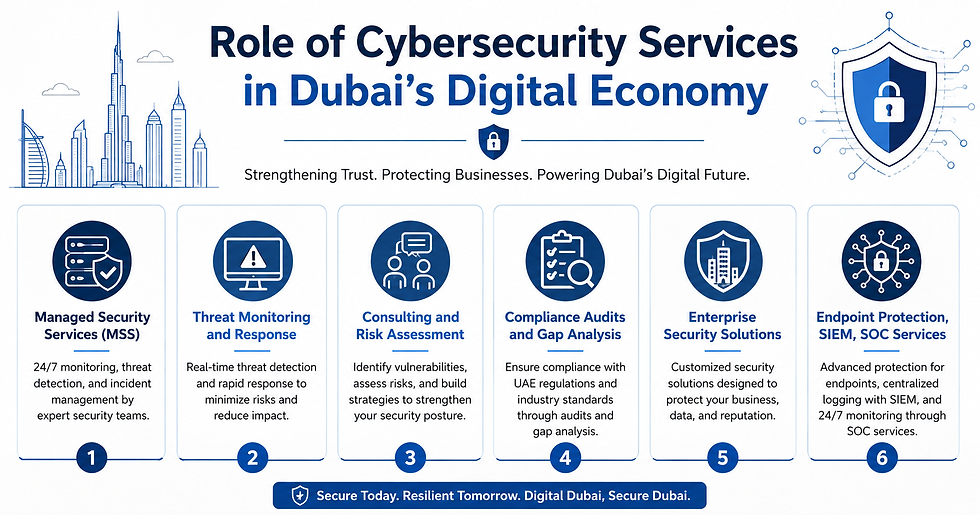
As Dubai accelerates its digital transformation, cybersecurity has become a strategic investment rather than a reactive IT function. Organizations across banking, healthcare, retail, logistics, manufacturing, and government are adopting cloud platforms, AI-driven applications, and connected devices at an unprecedented pace. While these technologies improve efficiency and innovation, they also expand the attack surface, making businesses more vulnerable to sophisticated cyber threats.
To stay resilient, organizations are increasingly investing in comprehensive cybersecurity UAE strategies that combine proactive monitoring, risk management, regulatory compliance, and advanced security technologies. Instead of relying on standalone security tools, businesses are partnering with experienced providers that deliver integrated protection across their entire digital infrastructure.
Managed Security Services (MSS)
Modern cyber threats operate around the clock, making continuous monitoring essential for businesses of every size. Managed Security Services (MSS) provide 24/7 threat detection, monitoring, and incident response to identify suspicious activity before it escalates into a costly security breach.
Managed security teams leverage advanced technologies such as Security Information and Event Management (SIEM), threat intelligence platforms, behavioral analytics, and AI-powered detection systems to monitor networks, cloud environments, endpoints, and applications in real time. When an anomaly is detected, security analysts investigate, contain, and respond quickly to minimize operational disruption.
For many organizations in Dubai, outsourcing security operations is more cost-effective than maintaining an in-house Security Operations Center (SOC). This approach gives businesses access to experienced cybersecurity professionals, enterprise-grade tools, and continuous monitoring without the significant investment required to build internal capabilities.
Businesses looking for comprehensive Cyber Security Services Dubai can benefit from managed security solutions that improve visibility, reduce response times, and strengthen overall cyber resilience.
Consulting and Risk Assessment
Technology alone cannot eliminate cyber risk. Organizations must first understand where their vulnerabilities exist and how those weaknesses align with regulatory requirements and business objectives.
Cybersecurity consulting begins with comprehensive risk assessments that evaluate an organization's infrastructure, applications, cloud environments, third-party integrations, and security policies. Security experts identify vulnerabilities, assess the likelihood and business impact of potential threats, and prioritize remediation efforts based on risk.
Compliance has become another major driver of cybersecurity investment in the UAE. Organizations operating in regulated sectors must demonstrate that they meet applicable cybersecurity, privacy, and data protection requirements. Regular compliance audits and gap analyses help businesses identify areas where existing security controls fall short of regulatory expectations while creating a clear roadmap for improvement.
Beyond compliance, cybersecurity consultants assist organizations with governance frameworks, security strategy development, business continuity planning, incident response planning, employee security awareness training, and cyber resilience initiatives. These services enable businesses to proactively manage digital risk instead of reacting after an incident occurs.
Implementing tailored Cybersecurity Solutions Dubai helps organizations align security investments with operational priorities while reducing long-term exposure to evolving cyber threats.
Enterprise Security Solutions
As cyber attacks become more sophisticated, organizations require multiple layers of protection rather than relying on a single security solution. Enterprise security combines preventive, detective, and responsive technologies to safeguard users, devices, applications, and sensitive business data.
One of the most critical components is endpoint protection, which secures laptops, desktops, mobile devices, and servers against malware, ransomware, and unauthorized access. Modern endpoint detection and response (EDR) solutions continuously monitor device activity, identify abnormal behavior, and enable rapid containment before threats spread across the network.
Security Information and Event Management (SIEM) platforms play a central role by collecting and correlating security data from multiple systems into a single dashboard. By combining log analysis with real-time threat intelligence, SIEM solutions help security teams detect advanced attacks that traditional security tools may overlook.
Many enterprises also rely on Security Operations Center (SOC) services to provide continuous monitoring, threat hunting, forensic investigations, and rapid incident response. Supported by AI-driven analytics and automation, SOC teams can significantly reduce the time required to detect, investigate, and mitigate cyber incidents.
As cyber attacks UAE continue to target businesses across critical industries, implementing layered enterprise security has become essential for protecting business continuity, customer trust, and regulatory compliance. Partnering with an experienced Cybersecurity Services Company Dubai enables organizations to deploy scalable security architectures that evolve alongside emerging threats and the rapidly expanding UAE cybersecurity market.
How Businesses in UAE Can Strengthen Cyber Defense
As digital transformation accelerates across the UAE, businesses can no longer rely on traditional security measures alone. Cyber threats are becoming more sophisticated, targeting organizations of all sizes through ransomware, phishing, insider threats, and cloud vulnerabilities. Building a resilient cybersecurity posture requires a proactive strategy that combines advanced technologies, well-defined security policies, employee awareness, and expert support. By adopting modern security frameworks and partnering with trusted cybersecurity professionals, organizations can significantly reduce risk while ensuring business continuity and regulatory compliance.
Security Best Practices
A strong cybersecurity strategy begins with implementing security controls that protect users, devices, applications, and data across the organization.
Zero Trust Architecture
Zero Trust is one of the most effective approaches to modern cybersecurity. Unlike traditional security models that automatically trust users within a corporate network, Zero Trust operates on the principle of "never trust, always verify." Every user, device, and application must continuously authenticate and prove its identity before accessing business resources.
This approach minimizes unauthorized access, limits lateral movement during attacks, and protects sensitive business data even if an attacker gains initial access to the network. As hybrid work environments and cloud adoption continue to grow, Zero Trust has become an essential component of enterprise security strategies across the UAE cybersecurity market.
Multi-Factor Authentication (MFA)
Passwords alone are no longer sufficient to defend against today's cyber threats. Multi-Factor Authentication (MFA) strengthens identity security by requiring users to verify their identity using two or more authentication factors, such as a password, biometric verification, or a one-time authentication code.
Implementing MFA significantly reduces the risk of credential theft, phishing attacks, and unauthorized account access. It is considered one of the most effective and cost-efficient security controls for protecting business applications, cloud platforms, email systems, and remote access environments.
Cloud Security Strategies
Cloud computing has become the backbone of digital innovation in the UAE, but it also introduces new security challenges. Misconfigured cloud environments, insecure APIs, weak access controls, and inadequate monitoring are among the leading causes of cloud-related security incidents.
Organizations should adopt a comprehensive cloud security strategy that includes:
Strong identity and access management (IAM)
Data encryption both at rest and in transit
Continuous security monitoring
Regular vulnerability assessments
Secure cloud configuration management
Backup and disaster recovery planning
Combining these practices helps organizations protect critical workloads while maintaining compliance with evolving security regulations and reducing exposure to increasingly sophisticated cyber attacks UAE.
Importance of Cybersecurity Partners
Cybersecurity has evolved into a specialized discipline that requires continuous monitoring, advanced technologies, and highly skilled professionals. For many organizations, maintaining an in-house security team capable of addressing today's rapidly evolving threat landscape can be both costly and resource-intensive.
Partnering with an experienced cybersecurity provider gives businesses access to dedicated security experts, cutting-edge technologies, threat intelligence, and around-the-clock monitoring without the operational burden of building these capabilities internally.
Outsourcing security services also enables organizations to respond more quickly to incidents, improve regulatory compliance, conduct regular security assessments, and implement industry best practices aligned with international security standards. This proactive approach allows internal IT teams to focus on business innovation while experienced specialists manage evolving cyber risks.
Whether organizations require managed detection and response, compliance consulting, vulnerability assessments, or security operations support, investing in professional Cyber Security Services Dubai provides the expertise needed to strengthen long-term cyber resilience.
Businesses seeking scalable protection can also benefit from tailored Cybersecurity Solutions Dubai that integrate advanced threat detection, cloud security, endpoint protection, and incident response into a unified security strategy. Working with a trusted Cybersecurity Services Company Dubai ensures that security programs remain effective as technologies evolve, regulatory requirements change, and the digital threat landscape continues to expand.
Future of Cybersecurity in UAE
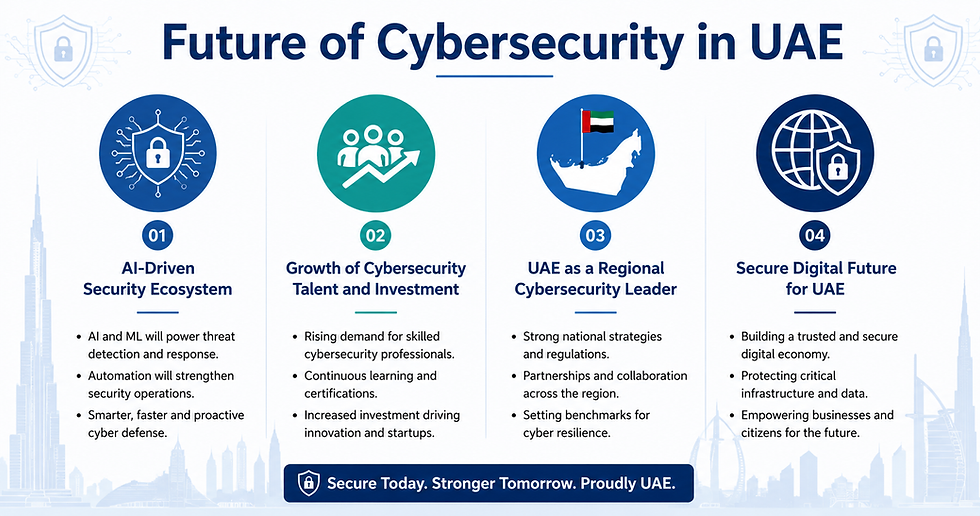
The future of cybersecurity in the UAE is being shaped by rapid technological innovation, increased digital adoption, and a strong commitment from both the public and private sectors to building a secure digital economy. As organizations embrace artificial intelligence, cloud computing, smart city initiatives, and the Internet of Things (IoT), cybersecurity will continue to evolve from a defensive function into a strategic business enabler.
Government-led initiatives, growing investments in digital infrastructure, and stricter regulatory frameworks are creating an environment where cybersecurity is no longer optional—it is a fundamental requirement for sustainable growth. As the UAE cybersecurity market continues to expand, businesses that invest in advanced security capabilities today will be better positioned to navigate future threats and capitalize on emerging digital opportunities.
AI-Driven Security Ecosystem
Artificial intelligence is transforming how organizations detect, prevent, and respond to cyber threats. Traditional security systems often rely on predefined rules, making them less effective against rapidly evolving attack techniques. AI-powered cybersecurity solutions, however, can analyze vast amounts of data in real time, identify unusual behavior, and respond to potential threats with greater speed and accuracy.
Machine learning algorithms continuously improve by learning from historical attack patterns, enabling security platforms to detect sophisticated threats such as ransomware, zero-day exploits, insider threats, and advanced persistent threats (APTs). AI also supports automated incident response by prioritizing alerts, reducing false positives, and accelerating threat containment.
As businesses across the cybersecurity UAE landscape increasingly adopt AI-driven technologies, security operations are becoming more predictive, intelligent, and resilient. This shift allows organizations to stay ahead of emerging cyber risks while improving operational efficiency and reducing response times.
Growth of Cybersecurity Talent and Investment
The increasing complexity of cyber threats has created strong demand for skilled cybersecurity professionals across the UAE. Organizations are investing not only in advanced security technologies but also in developing the expertise required to manage modern cyber risks effectively.
Government initiatives, university partnerships, professional certifications, and specialized training programs are helping build a highly skilled cybersecurity workforce capable of supporting the country's digital transformation goals. At the same time, businesses are increasing investments in Security Operations Centers (SOCs), managed security services, cloud security, threat intelligence, and cyber resilience programs to strengthen their security posture.
Private sector investment is also accelerating as industries including banking, healthcare, energy, telecommunications, logistics, and e-commerce recognize cybersecurity as a strategic business priority rather than simply an IT expense. This sustained investment is expected to drive continued innovation and long-term growth across the UAE cybersecurity market.
UAE as a Regional Cybersecurity Leader
The UAE has positioned itself as one of the Middle East's leading cybersecurity hubs through proactive government policies, robust digital infrastructure, and a forward-looking approach to innovation. National strategies focused on digital transformation, smart cities, artificial intelligence, and critical infrastructure protection have made cybersecurity a central pillar of economic development.
Dubai, in particular, has become an attractive destination for global technology companies, cybersecurity vendors, startups, and managed security providers seeking to serve businesses across the Gulf region. This thriving ecosystem encourages collaboration between government agencies, private enterprises, and technology innovators to strengthen cyber resilience and address emerging digital threats.
As cyber attacks UAE continue to grow in sophistication, organizations will increasingly prioritize integrated security strategies that combine AI-powered threat detection, regulatory compliance, continuous monitoring, and proactive risk management. Businesses that partner with experienced providers offering comprehensive Cybersecurity Solutions Dubai and Cyber Security Services Dubai will be better equipped to protect critical assets while supporting long-term digital innovation.
Looking ahead, the UAE's continued investment in technology, cybersecurity talent, and regulatory excellence is expected to reinforce its position as a regional leader in cyber resilience, creating new opportunities for businesses, investors, and cybersecurity providers alike. Organizations working with a trusted Cybersecurity Services Company Dubai will be well positioned to adapt to the evolving threat landscape and thrive in the country's increasingly digital economy.
Why Choose SISGAIN for Cybersecurity Services in Dubai?
SISGAIN delivers reliable cybersecurity solutions that protect your business from evolving threats. Our experts provide proactive security, compliance support, and risk management tailored to your organization's needs.
We offer end-to-end cybersecurity services, including threat monitoring, cloud security, vulnerability assessments, and incident response. Partner with SISGAIN to strengthen your security posture and keep your business protected.
Conclusion
Dubai's cybersecurity market is experiencing unprecedented growth, fueled by rapid digital transformation, increasing adoption of artificial intelligence, and a regulatory environment that prioritizes data protection and cyber resilience. As businesses continue to embrace cloud computing, smart technologies, and AI-driven innovation, the complexity and frequency of cyber attacks UAE are also increasing, making robust cybersecurity strategies more important than ever.
Success in today's digital economy depends on more than deploying security tools—it requires a proactive, risk-based approach that combines continuous monitoring, regulatory compliance, employee awareness, and advanced threat detection. From implementing Zero Trust architectures to leveraging AI-powered security operations, organizations across the UAE cybersecurity market are investing in comprehensive security frameworks to protect their critical assets and maintain customer trust.
Cybersecurity is no longer an optional IT investment; it is a business imperative that supports operational resilience, regulatory compliance, and long-term growth. Whether your organization is looking to strengthen its security posture, meet evolving compliance requirements, or prepare for emerging digital threats, partnering with experts offering Cyber Security Services Dubai, tailored Cybersecurity Solutions Dubai, and end-to-end support from a trusted Cybersecurity Services Company Dubai can help build a resilient foundation for sustainable business success in an increasingly connected world.
Frequently Asked Questions
What is driving the rapid growth of the cybersecurity market in Dubai?
The market is growing because of digital transformation, AI adoption, stricter regulations, and the rising number of cyber threats targeting businesses.
How is artificial intelligence improving cybersecurity in the UAE?
AI helps detect threats faster, automate responses, reduce false alerts, and improve overall security monitoring.
Why are cybersecurity services important for businesses in the UAE?
They protect business data, prevent cyber attacks, ensure compliance, and support business continuity.
What industries in the UAE need cybersecurity the most?
Banking, healthcare, government, retail, energy, and telecommunications are among the sectors with the highest cybersecurity needs.
How can businesses choose the right cybersecurity partner in Dubai?
Choose a provider with proven expertise, 24/7 monitoring, compliance knowledge, and end-to-end cybersecurity solutions.



Comments