How Healthcare Software Solutions Are Helping Hospitals Deliver Better Patient Experiences

1. Introduction
Patient care has changed more in the last decade than in the previous fifty years combined. Hospitals that once relied on paper charts, manual appointment books, and long check-in queues are now expected to offer the same speed and convenience patients get from banking apps or online shopping platforms. This shift is not just about technology for its own sake — it reflects a fundamental change in what patients expect from the healthcare experience.
Today's patients want fast appointment booking, clear communication, and treatment plans that reflect their personal medical history rather than generic protocols. They want to know their records are secure, their questions will be answered quickly, and their time will not be wasted in crowded waiting rooms. Meeting these expectations consistently is difficult without the right digital infrastructure in place.
This is where healthcare software solutions play a defining role. By connecting clinical teams, administrative staff, and patients on unified digital platforms, hospitals can reduce friction at every touchpoint — from the moment a patient books an appointment to the moment they receive follow-up care after discharge. The result is a healthcare system that is not only more efficient internally but also more responsive and personal from the patient's point of view.
2. The Role of Healthcare Software Solutions in Modern Hospitals
Hospitals are complex organizations with many moving parts: clinical departments, laboratories, pharmacies, billing offices, and administrative teams all need to work together seamlessly. Healthcare software solutions exist to bring these moving parts into one coordinated system, replacing scattered spreadsheets, paper files, and disconnected tools with a single source of truth.
Streamlining Daily Operations
Digital platforms automate routine tasks such as patient registration, bed management, inventory tracking, and staff scheduling. Instead of manually cross-checking availability or chasing down paperwork, hospital staff can rely on software to handle repetitive processes, freeing up time for higher-value work like patient care.
Improving Communication Between Patients, Doctors, and Staff
Miscommunication is one of the biggest sources of frustration in healthcare, both for patients and providers. Integrated software solutions create shared communication channels where doctors, nurses, and administrative teams can access the same patient information in real time, reducing the chances of errors caused by outdated or incomplete data.
Reducing Manual Processes and Improving Efficiency
Every manual process — a handwritten prescription, a phone call to confirm an appointment, a paper referral — introduces delay and the possibility of human error. Automating these workflows through healthcare software reduces administrative overhead and allows hospital staff to focus on patients rather than paperwork.
The Shift Toward a Modern Hospital Information System
At the center of this transformation is the move toward a Modern Hospital Information System that connects departments, digitizes records, and supports real-time decision-making. Rather than operating as isolated units, hospital departments using a modern information system can share data instantly, coordinate care more effectively, and respond faster to patient needs. This connected approach is quickly becoming the standard for hospitals that want to remain competitive and deliver consistently high-quality care.
3. Enhancing Patient Experience Through Digital Healthcare Solutions
Faster Appointment Scheduling and Patient Access
Long hold times on the phone and confusing paper-based booking processes are quickly becoming a thing of the past. Online booking systems and digital patient portals allow patients to schedule, reschedule, or cancel appointments in a few taps, at any time of day. This convenience alone significantly improves patient satisfaction, since it removes one of the most common pain points in the healthcare journey.
Beyond convenience, digital scheduling tools also help hospitals manage capacity more intelligently. By analyzing appointment patterns, hospitals can reduce no-shows, balance provider workloads, and cut down on waiting times — all of which contribute to a smoother, less stressful experience for patients.
Better Patient Communication and Engagement
Keeping patients engaged and informed throughout their care journey is essential for both satisfaction and health outcomes. Automated reminders and notifications — for upcoming appointments, medication schedules, or necessary follow-ups — help patients stay on track without needing to remember every detail themselves.
Equally important are secure communication channels that let patients message their healthcare providers directly, ask questions about test results, or request prescription refills without needing an in-person visit. These tools build trust and make patients feel more involved in their own care, rather than passive recipients of instructions handed down after a brief appointment.
Personalized Healthcare Through Data-Driven Insights
Every patient is different, and effective care depends on understanding each patient's unique history, risk factors, and preferences. Healthcare software solutions make it possible to bring together data from multiple sources — past visits, lab results, medications, and specialist notes — into a single, centralized record.
This centralized view supports better clinical decision-making and ensures continuity of care, particularly when patients see multiple providers or transition between departments. Instead of starting from scratch at every visit, doctors can build on a complete picture of the patient's health, leading to more accurate diagnoses and more personalized treatment plans.
4. The Impact of Custom Telemedicine Solutions on Patient Care

Telemedicine has moved from being a convenient add-on to becoming a core part of how hospitals deliver care. Virtual consultations allow patients to connect with doctors from home, cutting down on travel time, reducing unnecessary hospital visits, and making healthcare more accessible to people with mobility challenges or time constraints.
However, generic telemedicine tools often fall short when it comes to matching a hospital's specific clinical workflows, compliance requirements, or specialty needs. This is where custom telemedicine software development becomes valuable. A tailored telemedicine platform can be built around a hospital's existing systems, ensuring that virtual visits integrate smoothly with scheduling, billing, and patient records rather than operating as a separate, disconnected tool.
Working with experienced telemedicine development services allows hospitals to build platforms that support secure video consultations, digital prescriptions, remote monitoring, and encrypted messaging — all while meeting healthcare data protection standards. These platforms are especially valuable for hospitals serving patients in remote or underserved areas, where access to specialists may otherwise be limited.
The benefits extend beyond convenience. By reducing unnecessary in-person visits, telemedicine helps hospitals manage capacity more effectively, freeing up physical resources for patients who genuinely need to be seen in person. For patients, it means faster access to care, fewer delays, and the ability to consult specialists without long journeys or extended waiting periods.
5. Improving Hospital Efficiency with Custom Healthcare Software
Why Hospitals Are Moving Beyond Traditional Systems
Off-the-shelf healthcare software is often built to serve a broad range of hospitals with generic workflows. While this can work for smaller facilities with straightforward needs, larger or more specialized hospitals frequently find that generic systems don't fully align with their internal processes, forcing staff to work around software limitations rather than benefiting from them.
Advantages of Tailored Healthcare Platforms Over Generic Software
Custom healthcare software is designed around a hospital's actual workflows rather than forcing the hospital to adapt to a rigid, pre-built system. This means fewer workarounds, better staff adoption, and software that scales alongside the organization's growth. Custom platforms can also be updated and expanded over time as the hospital's needs evolve, something that is far more difficult with off-the-shelf solutions.
Managing Records, Billing, Appointments, and Clinical Workflows in One System
A well-designed custom system brings together patient records, billing, appointment scheduling, and clinical workflows under one roof. This unified approach reduces duplicate data entry, minimizes errors from disconnected systems, and gives hospital staff a complete view of each patient's journey — from the first appointment through billing and follow-up care.
The Importance of Custom Hospital Management System Development in UAE
For hospitals in the region looking to scale efficiently while meeting local regulatory and operational demands, Custom Hospital Management System Development in UAE has become an important strategic investment. A system built specifically for a hospital's structure and patient volume supports smoother operations today while remaining flexible enough to accommodate future growth, new departments, or additional facilities.
6. How Healthcare Software Development Is Supporting Hospitals in the UAE
Growing Adoption of Digital Healthcare Solutions Across the Region
The UAE has positioned itself as a regional leader in healthcare innovation, with hospitals increasingly investing in digital infrastructure to match rising patient expectations and national healthcare modernization goals. This growing adoption reflects a broader recognition that digital transformation is no longer optional for hospitals that want to remain competitive.
How Healthcare Software Development Dubai Is Helping Hospitals Modernize
Hospitals across Dubai are turning to specialized development teams to modernize their operations from the ground up. Healthcare Software Development Dubai initiatives focus on building platforms that address the specific operational, regulatory, and patient-experience needs of hospitals operating in this fast-growing healthcare market. These projects often combine appointment management, EHR systems, telemedicine, and billing into cohesive digital ecosystems.
The Role of a Healthcare Software Company Dubai in Building Secure Platforms
Data security is one of the most critical considerations in healthcare technology, given the sensitivity of patient information. A trusted Healthcare Software Company Dubai brings the technical expertise needed to build platforms that are not only functional and user-friendly but also secure and compliant with relevant healthcare data protection standards. This combination of security and usability is essential for hospitals that need to protect patient trust while delivering modern digital experiences.
Meeting Regional Healthcare Standards with Technology-Driven Solutions
Beyond convenience and efficiency, healthcare software must also align with regional compliance requirements and healthcare authority guidelines. Purpose-built systems designed with these standards in mind help hospitals avoid compliance risks while still delivering the modern, patient-centered experience that today's healthcare consumers expect.
7. Key Features of Effective Healthcare IT Solutions
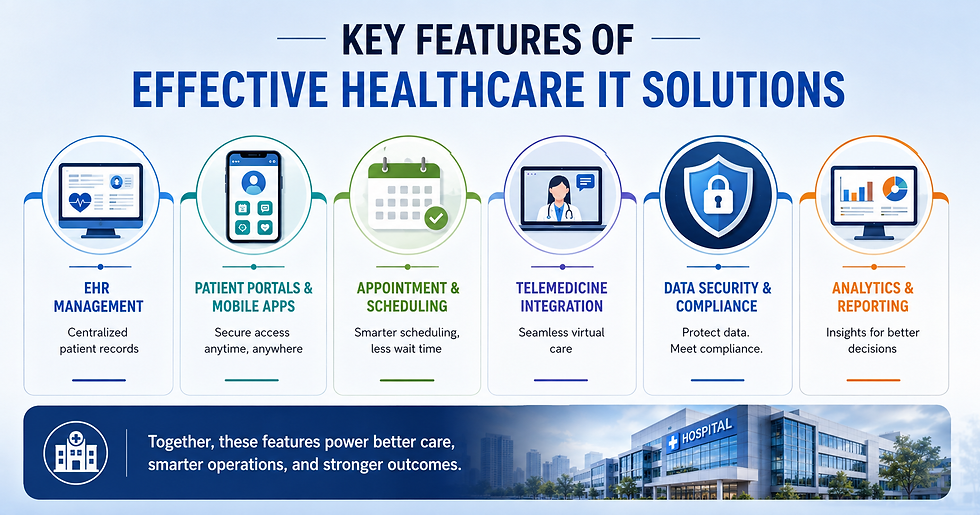
Not all healthcare software is created equal. The most effective platforms typically share a core set of features that directly support both clinical quality and patient satisfaction:
Electronic Health Records (EHR) Management – Centralized, accurate, and easily accessible patient records that support continuity of care across departments and providers.
Patient Portals and Mobile Healthcare Applications – Convenient, secure access for patients to view records, book appointments, and communicate with providers from their phones or computers.
Appointment and Scheduling Systems – Automated, intelligent scheduling tools that reduce wait times and improve resource allocation.
Telemedicine Integration – Seamless virtual care options built directly into the hospital's existing digital ecosystem.
Data Security and Compliance Features – Encryption, access controls, and audit trails that protect sensitive patient data and meet regulatory requirements.
Analytics and Reporting Tools – Dashboards and reports that give hospital leadership visibility into operational performance and patient outcomes, supporting better decision-making over time.
Together, these features form the foundation of a healthcare IT ecosystem capable of supporting both day-to-day operations and long-term strategic goals.
8. Why Hospitals Need Custom Healthcare IT Solutions in UAE

Addressing Unique Operational Challenges
Every hospital has its own mix of departments, patient volumes, specialties, and workflows. Generic software often struggles to accommodate these differences, leading to inefficiencies that ripple through the entire organization. Custom Healthcare IT Solutions in UAE are designed specifically to address these unique operational realities, rather than forcing hospitals to adapt their processes to fit a one-size-fits-all system.
Improving Scalability and Flexibility
As hospitals grow — whether by adding new departments, expanding to new locations, or increasing patient capacity — their software needs to grow with them. Custom solutions are built with scalability in mind, allowing hospitals to add new features and capabilities without needing to replace their entire system every few years.
Supporting Better Patient Outcomes Through Connected Systems
When clinical, administrative, and patient-facing systems are all connected, care teams have better visibility into each patient's history and current status. This connectivity supports faster, more informed clinical decisions, which in turn contributes to better patient outcomes and fewer avoidable errors.
Choosing the Right Healthcare IT Solutions Company in the UAE
Given the complexity and sensitivity of healthcare technology, selecting the right development partner matters significantly. Hospitals should look for a healthcare IT solutions company in the UAE with proven experience in the region's regulatory environment, a track record of successful hospital implementations, and the technical capability to build secure, scalable, and user-friendly systems tailored to each hospital's specific needs.
9. Future Trends in Healthcare Software Development
Healthcare software continues to evolve rapidly, and several emerging trends are set to shape the next generation of hospital technology:
Artificial Intelligence in Healthcare Management – AI is increasingly being used to support diagnostic accuracy, automate administrative tasks, and identify patterns in patient data that might otherwise go unnoticed, helping clinical teams make faster and more informed decisions.
Remote Patient Monitoring – Wearable devices and connected sensors are enabling hospitals to track patient health metrics outside traditional clinical settings, allowing for earlier intervention and reduced hospital readmissions.
Predictive Analytics for Better Decision-Making – By analyzing historical and real-time data, predictive analytics tools help hospitals anticipate patient needs, optimize staffing, and identify potential health risks before they become serious.
More Connected and Patient-Centric Healthcare Ecosystems – The future of healthcare technology is moving toward fully integrated ecosystems where every touchpoint — from initial booking to post-discharge follow-up — is connected, data-driven, and designed around the patient's experience.
Hospitals that invest early in these emerging technologies will be better positioned to meet evolving patient expectations and maintain a competitive edge in an increasingly digital healthcare landscape.
10. Conclusion
Healthcare software solutions are fundamentally reshaping how hospitals interact with patients — from the first appointment booking to ongoing communication, personalized treatment, and long-term care management. What once required long waits, disconnected systems, and manual processes can now be handled through secure, efficient, and patient-friendly digital platforms.
Investing in secure, customized, and future-ready healthcare technology is no longer a luxury reserved for large hospital networks — it is becoming a baseline expectation for any healthcare organization that wants to deliver consistently high-quality care. Whether through a Modern Hospital Information System, custom telemedicine software development, or a fully tailored Custom Hospital Management System Development in UAE, the right technology investment pays off in smoother operations, stronger patient relationships, and better health outcomes.
Hospitals that partner with the right healthcare IT solutions company in the UAE and embrace this digital transformation are not just improving their internal processes — they are building the kind of patient-focused, efficient, and trustworthy healthcare experience that today's patients expect and deserve.


Comments