UAE Cybersecurity Market 2026: AI Growth, Cloud Security, SOC Demand & Emerging Threats
The UAE is moving fast on AI, cloud, and digital services. Every new AI tool, cloud system, and online customer account also gives attackers something new to target. Companies that plan AI, cybersecurity, and cloud security as three separate projects usually end up with gaps between them. The businesses that do well plan all three together.
This guide explains where the UAE market stands in 2026, which security services companies need, how to choose a provider, what it costs, and what to focus on over the next few years. It is written for business leaders, IT managers, and anyone who has to make decisions about AI and security in a fast-changing environment.
What does the UAE AI and cybersecurity market look like in 2026?
Demand is strong across most sectors. Banks, hospitals, government bodies, energy companies, and retailers are all spending more on digital systems, and every new system needs protection. Much of the growth now comes from AI itself. Companies want AI tools that are secure from day one, which is why many are looking for an AI development company in UAE that builds security into the work from the start, rather than patching it on later.
Cloud security is one of the fastest-growing parts of this picture. More companies move data and applications to the cloud, often across more than one provider. Each move adds settings to get right, accounts to protect, and places where attackers can look for weak spots. That is why demand for cloud security solutions in Dubai and across the UAE keeps rising, especially from companies that have grown quickly and now run systems on several platforms at once.
Market size figures change often, and forecasts from different research firms can vary a lot. If you are planning a budget or writing a report, check the latest numbers from the original research source before you rely on them. A single number taken out of context can lead to poor decisions, so look at the assumptions behind any forecast too.
Where is the biggest gap right now?
Several gaps show up again and again in UAE businesses, and most companies have at least three of them.
The first is talent. There are not enough skilled security analysts to staff a 24/7 operations center in-house, and experienced cloud security engineers are in high demand. Many companies turn to outside providers because hiring and keeping a full team is slow and expensive.
The second is old systems. Many organizations still run software with known flaws because patching is risky, takes downtime, or simply gets pushed back quarter after quarter. Attackers know this, and they often target the oldest systems first because they are the easiest to break into.
The third is AI governance. Teams adopt AI tools quickly, often without clear rules about what data those tools can see, who approved them, or what happens when they make a mistake. Governance usually lags behind adoption by a year or more.
The fourth is regulation. A single company may need to meet national rules, emirate-level rules, and sector rules at the same time. These overlap, but they are not identical, so compliance work often gets duplicated.
The fifth is distributed denial-of-service (DDoS) attacks, which keep growing in size and frequency. A flood of traffic can take a website or payment service offline in minutes, and the cost of downtime adds up fast.
The last major gap is multi-cloud complexity. When a company uses AWS, Azure, and Google Cloud together, each one has its own logs, settings, and security tools. Without central visibility, it is easy to miss a problem until it becomes a headline.
What is multimodal AI, and why does it matter for UAE companies?
Early AI tools handled one kind of input at a time. You typed text and got text back. Multimodal AI works with several kinds of data together: text, images, audio, and video. A system might read a scanned form, look at a photo of a damaged product, and listen to a voice note in the same task. For many businesses, this is much closer to how real work happens.
Traditional AI systems were usually built for one narrow job, like sorting emails as spam or not spam. Multimodal systems can handle messier, real-world inputs and connect information across formats. That makes them useful in hospitals, banks, logistics hubs, and government offices, where information rarely arrives in one neat format.
Companies looking for multimodal AI development services in Dubai usually want help with three things: choosing the right platform, connecting it to their own data, and adding the controls needed to use it safely. Most businesses will not build a model from scratch. They will pick a platform, train or configure it on their own data, and build the checks around it.
The main question for UAE businesses is not whether to use these tools but how to use them responsibly. Data privacy rules, data residency requirements, and the risk of wrong answers all matter. A model that gives a confident but incorrect answer can cause real harm in a clinical or financial setting, so accuracy checks need to be part of the design.
What is driving the growth of multimodal AI?
Several things are pushing it forward. Newer model designs handle text and images together far better than earlier systems. Cloud computing and specialized chips have made it cheaper to run these models at scale. More industries are building tools for specific jobs instead of using general-purpose models for everything. And many companies now use generative AI in daily work, from customer support to internal search and document review.
Dubai's position as a regional business hub also helps. Many companies in the region want local partners who understand both the technology and the local rules, and that is creating demand for AI software development in Dubai that can serve clients across the Gulf.
Which big players are shaping this space?
Large technology companies such as OpenAI, Google, Microsoft, Amazon Web Services, and Meta offer multimodal AI platforms that businesses can access through APIs or cloud services. Smaller companies are building specialized tools, often for a single industry, such as medical imaging, insurance claims, or industrial inspection. Many UAE businesses will combine a major platform with a specialized tool and a local development partner who connects everything together.
Where can UAE businesses use multimodal AI?
The most useful cases tend to be practical rather than flashy. In healthcare, AI can review medical images alongside patient records, helping clinicians compare information faster. Banks and insurers use it to catch fraud by combining transaction data with device and behavior signals.
Retailers use it to understand customer questions across chat, photos, and product reviews. Logistics firms use it to inspect shipments, read damaged-goods photos, and track vehicles. Government agencies use it to answer citizen questions and process documents faster.
Multimodal operations in Dubai are also growing inside larger companies, where teams need to pull answers from scattered files, emails, call recordings, and images. A field engineer might photograph a broken part and ask the system what it is and how to order a replacement. An HR team might search a mix of policy PDFs and training videos for one answer. Used well, these tools save hours each week, but only if the data behind them is clean and well organized.
What are the risks and gaps?
Good training data is hard to find, especially labeled data in Arabic and other regional languages. Many models are trained mostly on English content, which can lead to weaker results for local users. Talent is limited. AI systems also use a lot of energy, which raises both cost and sustainability concerns. Many industries still lack tools built for their specific needs, so companies end up customizing general tools, which takes time.
Security is another major issue. AI systems can be attacked through their inputs, and "shadow AI," meaning tools staff use without approval, can leak sensitive data. Companies also need to watch for AI systems that act on their own, such as agents that send emails or change records, because a single mistake can spread quickly.
The main challenges for UAE enterprises are privacy, governance, accuracy, data sovereignty, and connecting new AI tools to older systems that were never designed for them. Each one needs a plan before a project goes live, not after.
How should a company start with multimodal AI?
Start small and pick one clear problem. A good first project has a measurable goal, such as cutting the time to process insurance claims by a set percentage or reducing manual review of product photos. Build a simple version, test it with real users, and measure accuracy honestly. Keep a person in the loop for decisions with real consequences. Expand only after the first project shows reliable results and the team understands the risks.
What cybersecurity services do UAE businesses need?

Most companies do not need every security service at once. A small business might start with basic monitoring and vulnerability checks. A large bank needs a full range. Knowing which services fit your situation saves money and avoids paying for tools you will never use.
A Security Operations Center (SOC) watches systems around the clock, looks for suspicious activity, and responds to alerts. Many businesses use a managed SOC run by an outside provider. Managed Detection and Response (MDR) and Managed Extended Detection and Response (MXDR) go further by actively hunting threats and responding to them, not just reporting them. SIEM tools collect logs from across the business and make them searchable, while SOAR tools automate routine response steps, such as isolating an infected laptop.
Vulnerability management finds weak points before attackers do, and it works best as a continuous process rather than a yearly exercise. Vulnerability assessment and penetration testing (VAPT) goes one step further and checks whether those weak points can actually be exploited. Incident response is the plan and the team that step in when a breach happens, and companies with an incident response retainer get help faster when something goes wrong. Digital forensics looks at what happened after an incident, which matters for recovery, insurance claims, and legal reasons. Threat intelligence tracks what attackers are doing now, so defenses can adjust before a new campaign reaches your systems.
Cloud security protects cloud accounts, workloads, and settings. Finally, compliance and governance, risk, and compliance (GRC) services help companies meet rules and prove they meet them.
Many companies look for managed cybersecurity services in Dubai that combine several of these into one contract, so they work with one partner instead of five. A bundled service can be cheaper and easier to manage, but make sure the bundle actually covers what you need, especially cloud and incident response.
Which industries need cybersecurity the most?
Banking and financial services face constant attacks because they handle money and sensitive identity data. Attackers often target them with phishing, account takeover attempts, and payment fraud. Government agencies hold citizen records and run critical services, which makes them attractive to both criminals and state-linked groups. Healthcare providers store large volumes of personal health data, and a breach can disrupt patient care, not just cause a privacy problem.
Energy and utilities run critical infrastructure, where a cyberattack can affect power, water, or fuel supply across a whole city. Retail and e-commerce companies handle payments and customer accounts, so they face fraud, card theft, and bot attacks. Transport, water, and telecom operators face growing pressure as their control systems connect to the internet, sometimes in ways their designers never planned for.
Are companies choosing cloud, on-premise, or hybrid security?
Most businesses now use a mix. Cloud-based security tools are easy to scale and update, which suits companies that run cloud-first systems. They also get new features faster and need less hardware. On-premise tools still matter for older systems and for environments where data must stay in a specific location. Some government and critical infrastructure systems fall into this group.
Hybrid models try to cover both. Large enterprises tend to run complex hybrid setups, with some tools in the cloud, some on site, and a central team watching both. Smaller companies often rely on managed services because building and running their own tools is too costly. For them, the question is less about where the tools live and more about who is watching them at 3 a.m.
How do enterprises and SMEs approach security differently?
Enterprises usually have dedicated security teams, formal policies, and budgets for specialized tools. Their challenge is often coordination, getting many teams and systems to follow the same rules. Small and medium businesses usually have less staff and less time, so they look for simple, bundled services that deliver the essentials: monitoring, backups, patching, and clear incident steps. Both groups benefit from the same basics, but the way they reach them is different.
Should you use a managed SOC or build an in-house team?
This decision comes down to cost, skills, and how much control you want.
An in-house team gives you full control and deep knowledge of your own systems. Analysts who work only for you learn your environment well and can make fast decisions based on that knowledge. But skilled analysts are expensive to hire and keep, and covering nights, weekends, and holidays takes several shifts of staff. You also have to buy, configure, and maintain the tools yourself, and those tools need constant tuning.
A managed SOC spreads the cost across many clients, provides 24/7 coverage without building shifts, and gives you access to tools and experts you could not easily hire. Providers also see attack patterns across many customers, which can help them spot a new campaign early. The trade-off is less direct control, so the relationship with your provider needs careful management, clear reporting, and regular reviews.
For many mid-sized companies, a managed service makes sense at the start. Large banks and government bodies often run a hybrid model, with an internal team setting strategy, owning the risk decisions, and working closely with an outside provider that handles round-the-clock monitoring.
How do you cover the gap between in-house and managed?
The most workable model often has three parts. The provider handles monitoring, alert triage, and first response. Your internal team owns policies, access decisions, and business impact calls. A shared runbook defines who does what during an incident. Without that runbook, teams lose time arguing about who should act, and attackers use that time.
How much does managed cybersecurity cost in the UAE?

Pricing usually depends on how many users, devices, or log sources you have, and how much monitoring and response you need. Common pricing models include per endpoint, per user, per device, per service, and based on how much data your SIEM ingests. Usage-based pricing can surprise companies whose log volumes grow quickly, so ask how spikes are handled.
The following ranges are typical for managed security services in the UAE. Actual prices vary by provider and scope, so treat them as a starting point rather than a quote.
A small business might pay roughly AED 12,000 to 25,000 per month for a SOC with managed detection and basic reporting. This tier usually covers monitoring, endpoint protection, and a monthly report. A mid-sized company might pay AED 25,000 to 120,000 per month for 24/7 SOC coverage, extended detection, and cloud monitoring. A large enterprise might pay AED 120,000 to 500,000 or more per month for full SIEM management, threat hunting, forensic support, and security across several cloud platforms.
Some costs sit outside the monthly fee. These include incident response retainers, compliance reporting, penetration testing, and advanced threat hunting. Multi-cloud work can add to the bill, since each platform needs its own connectors and tuning. Ask for a clear breakdown, because the cheapest quote may leave out the services you will need most during a real incident.

What should you compare when you get quotes?
Compare what is included, not just the headline number. Check the response time for critical alerts, the number of analysts who will handle your account, whether reporting is monthly or real time, how log storage is priced, and whether incident response hours are included or charged separately. Ask for a sample monthly report. A good report explains what happened, what was done, and what the team recommends next, in plain language your leadership can read.
How do you choose a managed SOC service provider in Dubai?
Start by asking what the provider actually does day to day. A strong managed SOC service provider in Dubai should explain how its SOC works, who watches your systems at night, how fast it responds to a critical alert, and how it cuts down on false alarms. Ask for examples of incidents they have handled and how they kept clients informed during those events. Vague answers are a warning sign.
Look at certifications, but do not stop there. Certifications show that a company has passed certain standards, but they do not guarantee that its analysts are skilled or that its processes work under pressure. Check whether the team has experience with the rules that apply to your sector. Ask whether monitoring is truly 24/7 and whether analysts work on site or remotely, since remote teams can still be effective if the handover process is clear.
Find out how the provider detects threats. Good answers mention both automated detection and human review, along with a process for tuning rules so there are fewer false alarms over time. Cloud skills matter more every year, so ask how they monitor AWS, Azure, Google Cloud, or whichever platforms you use. A provider that only understands on-premise networks may struggle with cloud logs and identities.
Industry experience counts. A provider that already works with banks or hospitals will understand your risks and audit requirements. It will also know which reports regulators expect. Finally, think about growth. Can the provider scale with you, and what happens to pricing if your business doubles in size or adds a new office?
What questions should you ask in a provider meeting?
Ask who your main contact will be, how often you will meet, and what happens when that person is unavailable. Ask how the provider handles a false alarm that wakes up your executive team, and how it avoids making that happen again. Ask how data is stored, where log data is kept, and how you can get it back if you leave. Ask for references from clients of similar size and sector, and actually call them. Many companies also ask whether a provider offers managed SOC provider in Dubai services with local presence, since on-site support can matter during a serious incident.
Local presence and data residency
For government and regulated industries, local presence and data residency are often requirements rather than preferences. If logs contain personal data, you need to know where they are stored and who can access them. Put these answers in writing in the contract, not just in a sales call.
What does cloud security look like in the UAE?
Cloud security protects data and applications that run on cloud platforms. Demand is rising for three main reasons. First, more companies use several cloud providers at once. Second, more new applications are built directly for the cloud rather than moved there later. Third, more AI workloads run in the cloud because that is where the computing power is. Each of these trends adds to the attack surface.
The attack surface has grown along with cloud use. Every account, API, container, and service account is a possible entry point. Many breaches come not from sophisticated hacking but from simple mistakes, like a storage bucket left open to the public, a test environment with real customer data, or an account with far more access than it needs. Cloud security is largely about catching these mistakes before attackers do.
This is why companies searching for cloud security UAE solutions usually want more than a single tool. They want visibility across accounts, automatic checks against good practice, and a way to fix problems quickly.
What are the most common cloud security problems?
Misconfiguration tops the list. Cloud platforms offer hundreds of settings, and one wrong setting can expose data to the whole internet. Identity and access problems are also common. People and systems often get more permissions than they need, and those permissions are rarely reviewed after the project that required them has finished. Public storage exposure still catches companies out, even experienced ones, often because a team wanted to share a file quickly and forgot to close the door afterward.
Many teams now use automated tools to find and fix these issues rather than relying on manual checks done once a quarter. Automated checks run continuously, flag drift from the approved setup, and in some cases fix problems automatically when the change is low risk. Automated remediation needs careful rules, though. A fix that breaks a live application is almost as bad as the original problem, so critical changes should still get a human review.
Multi-cloud setups add complexity. Each provider has its own tools, logs, and rules, so getting one clear view across all of them takes deliberate work. Companies need central monitoring and the ability to apply the same security policy on every platform. Without this, the same mistake may be fixed on one platform and quietly left open on another.
Why does non-human identity matter so much?
Many accounts in a cloud environment do not belong to people. They belong to APIs, service accounts, containers, automated scripts, and now AI agents. These identities often have broad access and rarely get reviewed, because nobody feels responsible for them. An attacker who steals one can move quietly through a system, and the activity can look like normal automated traffic.
Good practice includes giving each identity only the access it needs, rotating credentials regularly, and using just-in-time access, which grants permissions only for the time they are needed. Companies should also keep an inventory of their machine identities, with an owner for each one. As AI agents spread, managing these identities will matter even more, because agents often act across many systems at once.
How do cloud security compliance and automation help?
Many UAE companies must meet several rules at once. These can include the UAE Information Assurance Standards (IAS), the Dubai Electronic Security Center's Information Security Regulation (DESC ISR), and the Personal Data Protection Law (PDPL). Keeping up with these by hand is slow and error-prone. Automated tools can check settings against required controls, flag gaps, and collect the evidence auditors ask for. This turns compliance from a yearly scramble into an ongoing process, and it frees your team to work on real risks.
What is data sovereignty, and why should UAE businesses care?
Data sovereignty means that data is subject to the laws of the country where it is stored. For UAE companies, this raises practical questions. Where is cloud data kept? Who can access it, including the cloud provider's own staff? Can it leave the country, and if so, under what conditions? Government and healthcare face strict rules here. Even where the law is looser, customers and partners increasingly expect to know where their information lives.
Data residency decisions belong in cloud design from the start. Fixing them later is costly and sometimes means rebuilding systems. A simple exercise helps: list every type of data your company holds, where each one is stored, and who needs access to it. The gaps you find will tell you where to focus.
Which cloud security tools should companies know about?

The market uses many acronyms, but the ideas are simpler than they sound. A Cloud-Native Application Protection Platform (CNAPP) covers the whole cloud application, from code and configuration to running workloads. Cloud Security Posture Management (CSPM) checks cloud settings against good practice and flags problems. Cloud Workload Protection Platform (CWPP) tools protect servers, containers, and serverless functions while they run. Cloud Infrastructure Entitlement Management (CIEM) manages who can access what across cloud accounts. Identity Threat Detection and Response (ITDR) watches for attacks on identity systems, such as stolen login tokens. Cloud Access Security Broker (CASB) tools control how users reach cloud apps, including unapproved ones.
Good coverage also includes API and application security, since many modern attacks target the way applications talk to each other. Companies looking for cloud security solutions in Dubai often want one platform that covers several of these functions rather than a patchwork of separate tools. A patchwork can work, but it creates gaps between tools and more work for the team.
What cloud security trends matter in 2026?
AI-native security is growing, with tools that use AI to spot unusual behavior and rank risks by how likely they are to be exploited. Zero Trust is becoming the default model, where no user or device is trusted just because it sits inside the network. Multi-cloud security and machine identity protection keep rising in importance. API security and container security matter more as applications are split into smaller connected pieces, each of which can be an entry point.
Some organizations are also starting to plan for post-quantum cryptography. This means preparing for future quantum computers that could break some of today's encryption. The work is mostly about knowing which systems use which encryption and planning upgrades over several years, rather than doing everything at once.
How do AI, cybersecurity, and cloud security work together?
This is the core idea of the whole picture. AI, cloud, and security are not separate projects. AI systems run in the cloud and handle sensitive data. Cloud environments need security that can keep up with fast changes. Security teams need AI to handle the volume of alerts they receive. When all three are planned together, each one makes the others stronger. When they are planned separately, the gaps between them are where attacks succeed.
Multimodal AI can help security teams by reading text from logs, screenshots, network data, and emails together. Instead of looking at each signal alone, an AI tool can connect them and show the analyst a clearer story of what happened. A suspicious login, an unusual file download, and a phishing email from the same week may look harmless on their own. Put together, they form a clear pattern.
How does AI help inside a Security Operations Center?
AI can sort incoming alerts, group related ones, and filter out many false positives before a person sees them. This matters because alert fatigue is one of the main reasons good analysts burn out and real threats get missed. A busy SOC can receive thousands of alerts a day, and most of them are noise. AI can also gather context automatically, such as recent logins, related devices, and past incidents, so analysts start with more information instead of spending their first hour collecting it.
The best setups keep a human in the loop. AI proposes and sorts, but people make the final call on serious incidents. Clear rules should define which actions the AI can take on its own, like blocking a known bad address, and which need approval, like shutting down a production server. A good AI-powered managed SOC service provider in Dubai will explain how its tools make decisions, how its analysts check those decisions, and how it measures accuracy over time.
How does AI support cloud security?
AI helps cloud tools spot unusual activity, such as a user suddenly downloading large amounts of data at an odd hour, or a service account calling an API it has never used before. It can enforce policies automatically, watch several clouds at once, and suggest or apply fixes. It can also rank risks so teams focus first on the problems most likely to be exploited. This matters because most organizations have far more findings than they can fix at once, and a long list with no priority is easy to ignore.
How does AI help stop fraud and phishing?
In banking and payments, AI looks at many signals together. These include transaction details, the device in use, typing or mouse patterns, location, and recent account changes such as a new phone number. Combining these signals catches account takeovers that a single rule would miss, and it does so without blocking every customer who travels or changes phones.
Phishing is changing too. Attackers now use convincing emails, fake images, cloned voices, and deepfake video. Defenses need to read message text, check images, look at how the sender usually behaves, and flag unusual requests, such as a sudden urgent payment from a senior executive. Staff training still matters, and people who know the warning signs remain the last line of defense. But tools that spot deepfakes and social engineering are becoming necessary, because a trained employee can still be fooled by a voice that sounds exactly like their manager.
What is shadow AI, and why is it a risk?
Shadow AI means employees using AI tools the company has not approved. A staff member might paste customer data into a public chatbot to get a quick summary, or connect an unvetted AI agent to a company email account to save time. The intent is usually good. The risk is real, because sensitive data can leave the company's control and be stored somewhere the company cannot audit.
The answer is not to ban AI, since that only pushes usage underground. Companies should set clear rules about which tools are approved, what data can go into them, and who is responsible for each AI agent. Offering approved tools that are easy to use reduces the pull toward unapproved ones. Monitoring and access controls catch problems early, and a short, plain-language policy helps staff understand the reasons behind the rules.
Businesses building AI agents should look for an AI agent development company in Dubai that designs security and governance in from the start, rather than adding them after launch. The same goes for teams looking for AI agent development solutions in Dubai. Governance should be part of the first design, covering what the agent can access, what it can change, how its actions are logged, and how a human can stop it. Companies that search for an AI agent development company Dubai often find that the best partners talk about governance in the first meeting, not as an afterthought.
How do you put Zero Trust into practice in Dubai?
Zero Trust is a simple idea with a lot of detail behind it. Instead of assuming that anyone inside the network is safe, every user, device, and application must prove who they are each time they ask for access. Access is limited to what each person or system needs, and it is checked continuously rather than once at login. The phrase "never trust, always verify" captures the idea, but the work is in the details.
Zero trust implementation in Dubai usually starts with mapping your identities, data, and applications. You need to know who uses what, which systems hold the most sensitive information, and how data moves between them. Many companies are surprised by how many old accounts, shared logins, and forgotten integrations they find during this step. That discovery is valuable in itself.
From there, you tighten identity controls, add strong multi-factor authentication, and reduce standing privileges, so people have admin rights only when they need them. Many companies start with their most critical systems, such as finance, customer data, and production cloud accounts, and then expand outward. Trying to change everything at once usually causes resistance and mistakes.
What does a good zero trust architecture look like?
A good zero trust architecture implementation in Dubai rests on a few pillars. Identity is the new perimeter, so strong authentication and identity checks come first. Devices must meet a baseline, such as up-to-date patches and encryption, before they reach sensitive data. Network access is divided into small segments, so a compromised laptop cannot reach everything. Applications are protected individually, and data is classified so that the most sensitive information gets the strongest controls. Logging and monitoring tie it all together, so the team can see what is happening and respond quickly.
Monitoring is essential. If a session suddenly behaves differently, such as a login from an unusual location or a large data transfer at night, the system should flag it or block it. Phishing-resistant authentication, such as FIDO2 security keys, is a strong choice for privileged accounts, because it is much harder for attackers to steal than a one-time code sent by text message.
Why does zero trust take time?
Zero Trust is not a product you buy once. It is a way of designing access, and it works best when it is part of the architecture from the beginning. Companies that retrofit it onto old networks often find the work slow and expensive, because legacy applications may not support modern authentication. Plan for a gradual rollout, expect some friction for users, and communicate clearly about why changes are happening. Small wins, such as securing the finance system first, build the confidence and support needed for later stages.
What threats should UAE companies watch in 2026?

Several threats stand out. AI-powered attacks let criminals write convincing phishing messages in fluent Arabic and English, find weak points faster, and automate parts of an attack. Ransomware remains one of the most damaging threats, and many modern attacks steal data first and then threaten to publish it if the ransom is not paid. This double pressure makes recovery harder even for companies with good backups.
Deepfake phishing uses fake voices and video to trick staff into approving payments or sharing credentials. A short call that sounds exactly like a senior manager can be enough to move money. Companies should set up a second-channel check for any unusual payment request, no matter how convincing it sounds.
Identity-based attacks are rising because stolen passwords and session tokens give attackers a way in without triggering alarms. Once inside with a valid login, an attacker can look like a normal user for weeks. DDoS attacks keep growing in size and frequency, and they can take down websites, apps, and online services. For retailers and banks, even a short outage can mean lost customers and public frustration.
Cloud misconfigurations remain a common cause of data exposure, often because a setting was changed for testing and never reverted. Supply chain attacks happen when criminals compromise a software vendor or service provider to reach its customers, which is why third-party risk now matters as much as internal security. Prompt injection is a newer risk: attackers hide instructions inside text that an AI system reads, tricking the system into doing something it should not, such as revealing data or sending a message. Unpatched legacy systems remain easy targets, since their flaws are well documented. Finally, insider risk and shadow AI can expose data even without an outside attacker, whether through carelessness or deliberate misuse.
What rules do UAE companies have to follow?
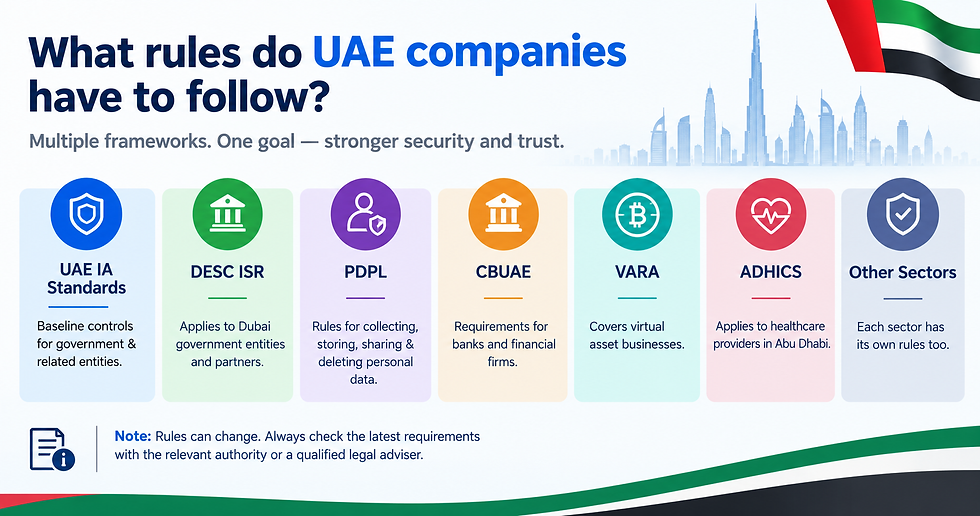
The UAE has several security and privacy frameworks, and they overlap. The UAE Information Assurance Standards set baseline controls for government and related entities. The Dubai Electronic Security Center's Information Security Regulation (DESC ISR) applies to Dubai government entities and their partners. The Personal Data Protection Law (PDPL) sets out how personal data must be collected, stored, shared, and deleted. The Central Bank of the UAE (CBUAE) sets requirements for banks and financial firms. The Virtual Assets Regulatory Authority (VARA) covers virtual asset businesses. The Abu Dhabi Healthcare Information and Cyber Security Standard (ADHICS) applies to healthcare providers in Abu Dhabi. Other sectors have their own rules too.
Because these rules change, always check the current text with the relevant authority or a qualified legal adviser before making compliance decisions.
Why is compliance getting harder?
Each framework has its own controls, and many ask for similar things in different words. Companies often end up doing the same work several times, such as collecting the same access review records for two different regulators. Compliance is also no longer a yearly exercise. Regulators and customers increasingly expect continuous monitoring and proof that controls work between audits. Collecting audit evidence by hand takes time and invites mistakes. Vendor risk adds another layer, since your security depends partly on the companies you work with, including their own weaknesses. Data residency rules add more complexity for companies running cloud systems across borders.
This is where cybersecurity compliance services in Dubai earn their keep. A good provider maps your controls to each framework once, so you are not doing the same evidence work three times, and keeps that mapping current as rules change. It also helps to name one person inside your company who owns compliance decisions, so the work does not get split across departments with no single owner.
Compliance-by-design helps most. When security and compliance requirements are built into systems from the start, the work is far easier than fixing things after an audit. Adding a control to a new system costs a fraction of retrofitting it into an old one.
What about NCAP accreditation?
Some providers and critical infrastructure operators reference NCAP accreditation. Accreditation signals that a provider meets a recognized standard, which matters when it handles sensitive systems. If your organization works with critical infrastructure, check the current requirements directly with the relevant authority, since accreditation rules can change. Ask any provider to show you its current accreditation status rather than relying on a logo on its website.
How do compliance services support daily security work?
Good compliance work does more than produce reports. It forces clear answers to basic questions: who has access to what, what data is stored where, how quickly incidents are reported, and how backups are tested. When those answers are written down and checked regularly, security improves as a side effect. Companies that treat compliance as a yearly paperwork exercise usually miss these benefits.
Where are the biggest cybersecurity and cloud security opportunities in the UAE?

Several areas stand out for businesses and service providers, and each one connects to the needs described above.
The talent shortage creates a clear opening for managed SOC services. Many companies need round-the-clock monitoring but cannot staff it. Training programs and hybrid delivery models, where a provider and an internal team share the work, also have growing demand. Companies that invest in training local analysts now will have an easier time hiring later.
Legacy infrastructure is another large area. Old systems carry known vulnerabilities, and many organizations lack the time or budget to replace them. Automated patch management, regular vulnerability assessments, and phased modernization can cut risk without a full rebuild. Often the best first step is simply knowing which old systems exist and which ones connect to the internet.
AI security is newer but growing fast. Testing AI systems for prompt injection, model weaknesses, and data poisoning, often called AI red teaming, is becoming a specialized service. The OWASP community publishes a list of the top risks for large language model applications, and many teams use it as a starting checklist. Companies offering multimodal AI development services in Dubai increasingly need security testing built into their delivery, not added at the end. A system that passes a demo may still fail when a clever user tries to manipulate it.
Supply chain security is also growing. Companies need to know which third-party software and services they depend on and how secure those vendors are. A Software Bill of Materials (SBOM) lists the components in a piece of software, which helps teams react quickly when a new flaw is announced. Vendor security questionnaires and periodic reviews help keep this under control.
Identity protection is another opportunity. Phishing-resistant multi-factor authentication is much harder to steal than a one-time code. Deepfake detection and executive protection are gaining interest, particularly for leaders who appear often in public or in recorded calls. Protecting the identities of people with high access is often the fastest way to reduce risk.
Post-quantum cryptography is a longer-term priority, especially for banking and government. The US National Institute of Standards and Technology (NIST) has published its first post-quantum standards. Organizations can start by listing the cryptography they use today and planning which systems to upgrade first. Data that must stay confidential for many years should be at the top of the list.
Which sectors have the most specific security needs?
Each sector has its own risks, so a one-size-fits-all approach rarely works.
Banking needs fraud detection, AI security, strong identity protection, and early planning for post-quantum readiness. Because banks handle large volumes of transactions, even a small improvement in fraud detection can save significant money. Healthcare needs patient data security, multimodal diagnostic tools that meet PDPL requirements, and secure cloud setups. Hospitals also need security that does not interfere with patient care, since a locked system during an emergency can be dangerous.
Government needs protection for critical infrastructure, sovereign cloud options, managed detection, and strong compliance. Government systems often combine old and new technology, which makes patching and monitoring harder. Energy and utilities need security for operational technology (OT) and industrial control systems such as SCADA, along with threat detection and protection for critical infrastructure. These environments were often designed for reliability rather than security, so the work must be careful not to disrupt operations.
Retail and e-commerce need payment security, fraud detection, customer identity protection, and AI-powered threat detection. Bot attacks, account takeovers, and card testing are constant problems for online stores. Logistics firms need security for computer vision systems, IoT devices, and cloud infrastructure. A warehouse full of connected sensors and cameras is a large attack surface if none of those devices are monitored.
What should UAE businesses prioritize in 2026?
If you are not sure where to start, work through these steps roughly in this order. Not every company needs every step at once, but the sequence helps most organizations.
First, set up an AI governance framework. Decide which AI tools are approved, what data they can use, who owns each AI system, and how outputs get checked. Build security into AI projects from the start, not after launch. A one-page policy that staff actually read is more useful than a long document nobody opens.
Second, move toward Zero Trust. Verify identity each time, give people only the access they need, and keep checking as sessions run. A solid zero trust architecture implementation in Dubai starts with identity and works outward to devices, networks, applications, and data.
Third, modernize your SOC. Use automation and AI to cut alert noise, but keep human analysts in charge of serious decisions. If you cannot staff a 24/7 team, look at managed options and check each managed SOC provider in Dubai against the criteria above. Make sure the provider's reports are clear enough for your leadership team to act on.
Fourth, secure multi-cloud environments with central visibility and consistent policies across all platforms. Choosing cloud security solutions in Dubai that work across providers will save you from managing several separate tools and the blind spots between them.
Fifth, strengthen identity controls, including those for machines and AI agents. Review service accounts, rotate credentials, and remove access that is no longer needed. Assign an owner to every machine identity so that nothing stays unmanaged.
Sixth, automate compliance monitoring. Continuous checks are cheaper and more reliable than a scramble before each audit, and they catch problems while they are still small.
Seventh, reduce legacy patch debt. List old systems, rank them by risk, and plan upgrades or protections for the worst ones first. Isolating old systems from the internet and tightening their access can buy time while upgrades are planned.
Eighth, begin preparing for post-quantum cryptography by inventorying the encryption you use today. Knowing where your encryption lives is useful for many other security tasks too.
Finally, set up continuous vulnerability management. Scanning once a year is not enough when systems change every week. Make vulnerability review a regular part of how your team works, with clear owners and deadlines for fixes.
What will the UAE AI and cybersecurity market look like from 2026 to 2035?
Several shifts are likely over the next decade. Security will move from traditional tools that wait for known patterns toward AI-native systems that learn from behavior and respond faster. Autonomous security operations will expand, handling routine responses without waiting for a person. Human oversight will remain important, especially for high-impact decisions, and the best systems will be designed to make that oversight easy.
Cloud-native platforms will become more common as companies run more of their business in the cloud. As that happens, security tools will need to understand containers, serverless functions, and APIs as well as traditional servers. Companies that build cloud-native habits early will adapt more easily.
Demand for AI governance will grow as regulations tighten and as companies deploy more AI agents. Non-human identity security will move from a niche concern to a standard part of every security program. Organizations will need to know how many machine identities they have, what each one can access, and who is responsible for it.
The lines between AI, cloud, and cybersecurity will keep blurring, so companies will increasingly buy them as one connected strategy rather than three separate products. Providers that can deliver all three well will have an advantage, and buyers will ask harder questions about how well each piece fits with the rest.
The UAE is well placed to become a regional hub for AI and cybersecurity. Its investment in digital infrastructure, clear regulatory direction, and location between major markets give it real advantages. Whether that potential is realized depends on talent development, local capability, and how widely businesses adopt secure practices from the start.
building a future-ready security strategy in the UAE
AI, cloud, and cybersecurity are deeply connected, and treating them as separate silos leaves gaps that attackers can use. A stronger approach combines AI-native tools, Zero Trust principles, and cloud security from the start. Compliance belongs in the design, not the audit. Continuous monitoring keeps defenses current as systems change, and clear governance keeps AI use under control.
For UAE businesses, the message is simple. Plan AI, cloud, and security work together, start with identity and governance, and make sure your protections keep pace with how fast your technology changes. Whether you build your own team, choose a managed SOC provider, or do both, the goal is the same: use AI and cloud with confidence, knowing the risks are understood and being managed. Companies that do this now will be better placed to use AI safely and to earn the trust of customers, partners, and regulators for years to come.

Frequently asked questions
What is the cybersecurity market size in the UAE in 2026?
Estimates vary by research firm and method. Check recent reports from recognized market research sources before using any single number, and note the date and assumptions behind it.
How fast is the UAE cybersecurity market growing?
It is growing steadily, driven by cloud adoption, AI deployment, and regulatory pressure. Growth rates differ by sector and by source, so compare several forecasts before drawing conclusions.
What are the most important cybersecurity services in the UAE?
For most organizations, the priorities are 24/7 monitoring through a SOC or MDR service, continuous vulnerability management, incident response planning, cloud security, and compliance support. The exact mix depends on your sector and risk level.
How much do managed cybersecurity services cost in Dubai?
Typical ranges are around AED 12,000 to 25,000 per month for small businesses, AED 25,000 to 120,000 for mid-sized companies, and AED 120,000 to 500,000 or more for large enterprises. Get detailed quotes, since scope and log volume drive the final price.
What are the best MSSPs in the UAE?
The right provider depends on your sector, size, compliance needs, and budget. Compare providers on SOC capabilities, certifications, industry experience, incident response track record, and pricing transparency. Ask for references from clients of similar size and sector, and speak with them directly.
What is the cloud security market size in the UAE?
Cloud security is one of the faster-growing segments of the market. Check current research for specific figures, and look at how each source defines the market, since definitions vary.
What are the biggest cybersecurity threats in the UAE in 2026?
AI-powered attacks, ransomware, deepfake phishing, identity-based attacks, DDoS, cloud misconfigurations, supply chain compromises, prompt injection, legacy system flaws, and insider or shadow AI risks are among the most significant.
How is AI changing cybersecurity?
AI helps security teams sort alerts, spot unusual behavior, investigate incidents faster, and detect fraud and phishing. Attackers use AI too, so defenses need to keep pace. Human oversight remains essential for serious decisions.
What is multimodal AI, and how is it used in cybersecurity?
Multimodal AI works with several data types at once, such as text, logs, images, and network data. In security, it connects these signals to give analysts a fuller picture of a threat, which speeds up investigations.
What is CNAPP?
CNAPP stands for Cloud-Native Application Protection Platform. It protects cloud applications across their life cycle, from code and configuration to running workloads, and often combines several cloud security functions in one platform.
What are UAE cybersecurity compliance requirements?
They depend on your sector and location. Common frameworks include the UAE Information Assurance Standards, DESC ISR in Dubai, the Personal Data Protection Law, and sector rules from bodies such as the CBUAE and VARA. For healthcare in Abu Dhabi, ADHICS applies. Confirm current requirements with the relevant authority.
What is shadow AI or agentic AI security?
Shadow AI is unapproved AI tool use inside a company. Agentic AI security covers the risks of AI agents that can act on their own, including their access to data and systems. Both need clear policies, monitoring, and access controls.
How can UAE businesses secure multi-cloud environments?
Use central visibility across all platforms, apply consistent policies, manage identities and permissions carefully, automate the detection of misconfigurations, and make sure your team or provider can monitor everything from one place.
What does zero trust implementation in Dubai involve?
It usually starts with mapping identities, data, and applications, then strengthening authentication, limiting access to what each user or system needs, segmenting networks, and monitoring continuously. Most companies roll it out in stages, beginning with their most critical systems.


Comments