Always Tired During Workouts? 7 Ways to Improve Your Stamina
Fifteen minutes into your workout and already gasping for air? You're not alone. For a lot of people, that's exactly how every session goes — legs feel heavy, energy disappears fast, and motivation follows right behind it. Most of the time, it comes down to one thing: low stamina.
Poor sleep, weak nutrition, not enough hydration, a sudden jump in training intensity, or just a lack of conditioning — any of these can drag your stamina down. And stamina isn't a "nice to have." It determines whether you can actually stay consistent with training, and whether you see results at all.
This guide breaks down why workout fatigue happens, and 7 practical, evidence-backed ways to actually build the stamina to push through it.
Why Do You Feel Tired During Workouts?
Short answer: Workout fatigue mostly comes down to weak cardiovascular conditioning, poor hydration, and insufficient sleep or recovery — sometimes combined with ramping up intensity too fast.
Common causes include:
Insufficient cardiovascular endurance — your heart and lungs can't deliver oxygen to muscles efficiently
Poor hydration and nutrition — the body simply doesn't have the fuel to produce energy
Inadequate sleep and recovery — muscles and the nervous system never fully repair
A sudden increase in workout intensity — the body hasn't had time to adapt
Long gaps between workouts — conditioning keeps resetting to zero
Overtraining and insufficient rest — the body slides into chronic fatigue
Every one of these traces back to the same root problem: the body isn't getting what it needs to produce energy. Here's how to fix that.
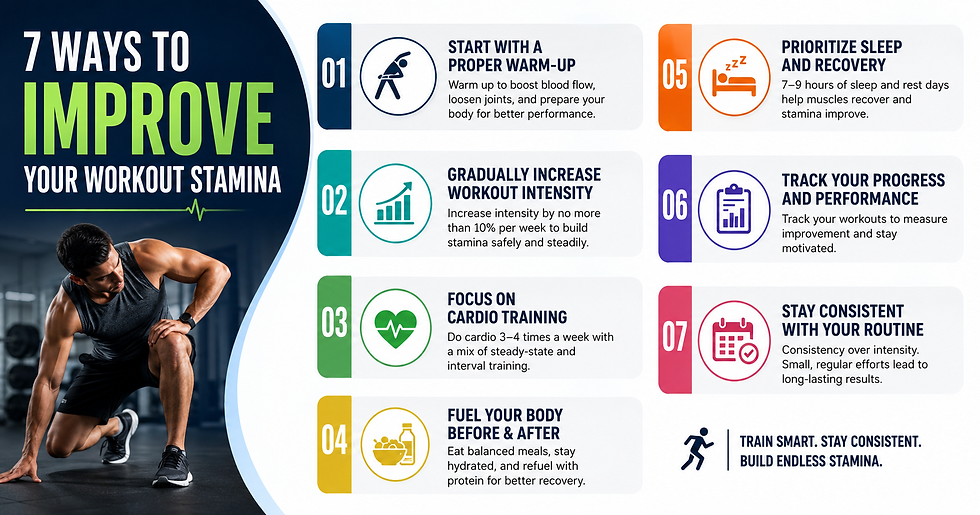
7 Ways to Improve Your Workout Stamina
1. Start With a Proper Warm-Up
Jumping straight into a heavy workout with cold muscles is one of the most common mistakes people make. Dynamic stretching and light cardio — leg swings, arm circles, or a brisk 5-minute walk — gradually prime both the muscles and the cardiovascular system.
A proper warm-up gets blood flowing to your muscles faster, loosens up your joints, and lets your heart rate climb gradually instead of spiking all at once. The payoff: your body tolerates workout intensity far better, and fatigue takes longer to set in.
2. Gradually Increase Workout Intensity
This is progressive overload — increasing duration, reps, resistance, or intensity in small increments over time, instead of doubling everything in a single session.
This is where beginners trip up most often. They start running 5km in their first week or lift heavy every single day, and within a couple of days the body burns out. A safe rule of thumb: don't increase intensity by more than 10% in any given week, whether that's reps, weight, or cardio duration.
Just as trainers follow a structured progression for gym members, digital tools now do the same thing. Custom fitness app development makes it possible to build apps that track personalized workout progression — meaning the app itself decides when a user is ready for more intensity, based on their actual performance data.
3. Focus on Cardiovascular Training
Stamina is built on cardiovascular fitness at its core. Running, cycling, swimming, and rowing all strengthen the heart and lungs, which means muscles get oxygen more efficiently during exercise.
There are two main approaches:
Steady-state cardio — a consistent pace held for 20-40 minutes (like jogging)
Interval training — short bursts of high intensity followed by recovery periods (like 30-second sprints, 1-minute walks)
A combination of both delivers the best results. Cardio 3-4 times a week, done consistently, beats one long, occasional session every time.
Technology plays a role here too. Companies offering sports mobile app development in the UAE build apps that track cardio sessions in real time — pace, distance, heart rate zones — so users can actually see their progress instead of just guessing at it.
4. Fuel Your Body Before and After Workouts
No car runs on an empty tank, and neither does the body. Eating a balanced meal 1-2 hours before a workout matters — carbohydrates are the primary source of energy production, supplying the glycogen muscles burn through during exercise.
Protein afterward is critical for recovery — it repairs torn muscle fibers and helps them come back stronger. Hydration matters just as much: water alone isn't enough, since electrolytes (sodium, potassium) also need replenishing, especially after heavy sweating.
A simple rule of thumb: if you feel dizzy or get a headache after a workout, it's usually a hydration or fueling issue — not a technique problem.
5. Prioritize Sleep and Recovery
Sleep has a direct impact on exercise performance. While you sleep, the body releases growth hormone, which drives muscle repair and recovery. Skip 7-9 hours of quality sleep, and stamina drops the next day automatically — even if diet and training are dialed in.
Skipping rest days does just as much damage. Muscles don't grow during the workout — they grow during rest. Active recovery — a light walk, yoga, or stretching — keeps blood circulation going without adding extra stress.
Signs your body needs more recovery time:
Muscle soreness that lingers past 3 days
Resting heart rate higher than usual
A sudden drop in motivation and focus
Poor sleep quality despite feeling exhausted
6. Track Your Progress and Workout Performance
What doesn't get tracked doesn't get improved. Logging heart rate, workout duration, calories burned, pace, and reps tells you whether stamina is actually improving — not just whether it feels like it is.
Manual tracking is prone to human error — people forget to log sessions, and numbers end up approximate at best. That's exactly why fitness tracking apps have taken off. A fitness app development company in the UAE typically builds apps with automated tracking, analytics, and visual progress dashboards — letting users directly compare their performance today against four weeks ago, instead of relying on memory.
7. Stay Consistent With Your Training Routine
Four moderate, consistent workouts beat one intense session every time. The body only adapts when the stimulus is regular — occasional burnout-level sessions just add fatigue without building stamina.
Set realistic goals — something like "4 days a week, 30 minutes" rather than "2 hours a day, every day." Small, consistent improvements compound into major results over time.
Gyms have started catching on to this too. A gym app development company in Dubai typically builds in features like member scheduling, attendance tracking, and engagement reminders — helping members stick to their training routine without relying purely on willpower.
How Technology Can Help Improve Workout Stamina
Fitness apps have moved well past simple tracking — a good one now functions closer to personalized coaching. Here's what that typically looks like:
Personalized workout plans — progression suggestions based on a user's current fitness level
Activity and performance tracking — automatically logging heart rate, calories, pace, and reps
Workout reminders and progress reports — support for staying consistent
User engagement — challenges, streaks, and community features that keep motivation up
Data-driven fitness routines — decisions based on real performance data, not guesswork
Companies offering sports app development services in Dubai often build features that work equally well for competitive athletes and casual users. Similarly, a sports software development company in Dubai typically handles the backend infrastructure for real-time data processing — so the app can deliver accurate feedback instantly.
The bottom line: technology doesn't build stamina by itself, but it does help you stay consistent, track accurately, and make smarter decisions along the way.
When Should You Be Concerned About Workout Fatigue?
Direct answer: Normal fatigue eases off within a few hours of finishing a workout. If fatigue is persistent, or comes with dizziness, chest pain, or difficulty breathing, that's a signal to get medical attention.
It helps to know the difference between normal and unusual fatigue:
Normal: muscles feel tired, breathing is a bit heavier than usual, but it clears up within a few hours
Unusual/Concerning: weakness that lasts all day, dizziness, tightness or pain in the chest, difficulty breathing, or an irregular heartbeat
If any of these warning signs show up, stop the workout immediately and consult a doctor. Building stamina matters, but ignoring the body's warning signals is never worth it.
Build Better Stamina With a Sustainable Fitness Routine

Stamina isn't an overnight achievement — it's the result of a sustainable system:
A balance of cardio and strength training — together they build both endurance and power
Nutrition + hydration + sleep — the body needs fuel and recovery time in equal measure
Progressive training — increasing intensity gradually, not rushing it
Consistent performance tracking — measuring progress with real data
A long-term approach — thinking in months, not the results of two weeks
People who try to rush stamina gains by overtraining usually burn out within 3-4 weeks. People who gradually work all of these elements into a routine see steady, sustainable improvement instead.
Conclusion
Feeling wiped out during workouts, over and over, is rarely caused by just one thing — it's the combined effect of sleep, nutrition, hydration, training intensity, and consistency.
Start with a proper warm-up, increase intensity gradually, make cardio a regular part of your routine, fuel your body properly, prioritize sleep and recovery, track your progress, and above all, stay consistent. These 7 steps work together — not in isolation.
And if you want extra support, fitness technology can be a genuinely useful tool — from tracking to personalized progression, it makes the process simpler and more data-driven. But the results ultimately come from the consistency you show up with, day after day.


Comments