Cloud Infrastructure Management: The Complete Guide for UAE Businesses
- sisgaintushar
- 5 days ago
- 11 min read
Most companies don't lose money on the cloud because they picked the wrong provider. They lose it because nobody is actively managing what they built. Servers sit idle at 3am. Backups run but nobody tests the restore. A security group gets left open during a migration and stays open for eight months.
Cloud infrastructure management is the discipline that closes those gaps — the ongoing work of monitoring, securing, optimizing, and evolving the compute, storage, and networking a business runs on, rather than just switching it on and hoping.
This guide walks through what that actually involves, how to plan for it, and what to look for in a partner if you're outsourcing it.
1. Introduction to Cloud Infrastructure Management
What is cloud infrastructure management?
Cloud infrastructure management is the ongoing process of provisioning, monitoring, securing, and optimizing the compute, storage, networking, and platform resources that support a company's applications and data. It's not a one-time setup task. It's the difference between deploying infrastructure and running it well over years, through scale-ups, security threats, and changing workloads.
Why it matters for modern businesses
A cloud environment left on autopilot degrades in predictable ways: costs creep up as unused resources pile up, security drifts as configurations change without review, and performance suffers as workloads outgrow the architecture they were built on. None of this shows up as a single dramatic failure. It shows up as a slowly rising bill, a slightly slower app, and a security gap nobody notices until something goes wrong.
Effective management catches these problems early — often before a customer or a finance team ever notices.
Key components
Cloud infrastructure management covers six interlocking areas:
Compute — virtual machines, containers, and serverless functions that run applications
Storage — object, block, and file storage, along with backup and archival tiers
Networking — VPCs, load balancers, DNS, CDNs, and the connections between them
Security — identity, access control, encryption, and threat monitoring
Monitoring — real-time visibility into performance, availability, and cost
Automation — infrastructure-as-code, auto-scaling, and orchestration that removes manual toil
How managed infrastructure improves scalability and efficiency
When these six areas are managed together instead of in isolation, infrastructure stops being a bottleneck. A retail business can handle a Ramadan traffic spike without a war room. A logistics company can add a new regional office without a two-week networking project. That's the practical payoff of doing infrastructure management properly: the business can grow without its IT foundation being the thing that slows it down.
2. Understanding Cloud Infrastructure Architecture
Core components of cloud infrastructure
Compute resources. Virtual machines remain the default for most workloads, but containers (via Kubernetes or managed container services) and serverless functions are increasingly handling variable or event-driven work. The right mix depends on how predictable your workload patterns are.
Cloud storage. Object storage (for unstructured data like files and backups), block storage (for databases and VMs that need low-latency disk access), and file storage (for shared access across systems) each solve a different problem. Using the wrong tier for the job is one of the most common — and most expensive — architecture mistakes.
Networking and connectivity. Virtual private clouds, subnets, load balancers, and content delivery networks determine how fast and how reliably data moves between users, applications, and other systems. For UAE businesses serving both regional and international customers, network design directly affects latency and user experience.
Databases. Managed database services reduce the operational burden of patching, backups, and failover compared to self-hosted databases, at the cost of some configuration flexibility.
Security and identity management. Identity and access management (IAM) governs who — and what system — can touch which resource. This is the layer most breaches actually exploit, more often than a technical vulnerability.
Public, private, and hybrid cloud architectures
Public cloud (AWS, Azure, Google Cloud) offers the fastest path to scale with no hardware to maintain. Private cloud keeps infrastructure on dedicated, often on-premises, hardware — a common choice for organizations with strict data residency or regulatory requirements. Hybrid architectures combine both, which is increasingly the default for UAE enterprises balancing local compliance needs against the elasticity of public cloud.
Designing for scalability and resilience
A resilient architecture assumes failure will happen and designs around it — redundant availability zones, automated failover, and no single point of failure. Scalability means the architecture can absorb 10x traffic without a redesign, typically through auto-scaling groups and stateless application design.
Designing infrastructure around business requirements
The technically "best" architecture isn't always the right one. A startup optimizing for speed to market has different needs than a bank optimizing for auditability. Good architecture design starts with the business constraint — compliance, budget, growth trajectory — and works backward to the technical decisions, not the other way around.
3. Key Cloud Infrastructure Management Services

Infrastructure monitoring and performance management. Continuous tracking of CPU, memory, disk, and network metrics, with alerting before thresholds become outages rather than after.
Cloud security and compliance. Ongoing vulnerability scanning, patch management, and configuration audits — not a one-time security review at launch.
Backup and disaster recovery. Automated, tested backups and a documented recovery plan with a defined recovery time objective (RTO) and recovery point objective (RPO).
Resource and cost optimization. Right-sizing instances, eliminating orphaned resources, and matching pricing models (reserved vs. on-demand) to actual usage patterns.
Network management. Ongoing tuning of load balancing, DNS, and connectivity as traffic patterns and application architecture change.
Automation and infrastructure orchestration. Infrastructure-as-code (Terraform, CloudFormation) and orchestration tools that make environments reproducible and reduce configuration drift.
Cloud migration and modernization. Moving workloads to the cloud, and just as importantly, re-architecting legacy applications to actually take advantage of cloud-native capabilities rather than just relocating a data center.
Businesses that need help implementing and coordinating these pieces day to day often turn to dedicated cloud infrastructure services in Dubai rather than building an internal team to cover every specialty from security to network engineering.
4. Cloud Strategy and Infrastructure Planning
Assessing current IT infrastructure
Before any cloud decision gets made, map what already exists: applications, dependencies, data flows, and the technical debt sitting underneath all of it. Skipping this step is why so many migrations run over budget — teams discover mid-project that an application has undocumented dependencies nobody accounted for.
Defining cloud adoption goals
Cost reduction, faster deployment cycles, improved uptime, or regulatory compliance are all valid goals — but they pull architecture decisions in different directions. A plan optimized purely for cost will look different from one optimized purely for speed.
Choosing the right cloud model
Public, private, or hybrid — the decision should follow from the assessment and goals above, not from whichever model is currently trending. Data residency requirements alone often push UAE businesses in regulated sectors toward hybrid models.
Workload assessment and prioritization
Not every application should move to the cloud at the same time, or in the same way. Some can be "lifted and shifted" with minimal change. Others need to be rebuilt to get any real benefit. Sequencing this correctly — starting with lower-risk, higher-value workloads — protects the rest of the roadmap from an early failure.
Cloud governance and resource planning
Governance defines who can provision what, how spending is tracked, and how policy is enforced across teams. Without it, cloud environments sprawl — different departments spin up resources independently, and nobody has a full picture of what's running or why.
Developing a scalable long-term roadmap
A cloud strategy isn't a one-time document. It's a roadmap that gets revisited as the business, the workloads, and the available cloud services all change. Organizations that treat their cloud strategy as "done" after the initial migration tend to be the ones paying for infrastructure they no longer need three years later.
For businesses that need structured help building this out, dedicated cloud strategy services in Dubai can shorten the planning cycle considerably by bringing migration and optimization experience the internal team doesn't have yet.
5. Managed Cloud Services for UAE Businesses
What are managed cloud services?
Managed cloud services hand day-to-day infrastructure operations — monitoring, security, backups, optimization — to a third-party provider, so internal teams can focus on the applications and products that actually differentiate the business.
Why businesses outsource cloud infrastructure management
Hiring a full in-house team with deep expertise across security, networking, databases, and every major cloud platform is expensive and hard to sustain, especially for mid-sized organizations. Outsourcing gets access to that breadth without the overhead of a large internal department. This is a big part of why demand for Managed Cloud Services in Dubai has grown steadily as more UAE companies scale their digital operations.
24/7 monitoring and technical support
Infrastructure problems don't wait for business hours. Round-the-clock monitoring catches issues — a failing disk, a spike in error rates — before they become downtime.
Security and compliance management
Managed providers typically run continuous vulnerability scanning, patch cycles, and compliance checks against frameworks relevant to the region and industry, which is harder to sustain consistently with a lean internal team.
Performance optimization
Ongoing tuning — right-sizing instances, adjusting auto-scaling rules, optimizing database queries — keeps performance from degrading quietly as usage patterns shift.
Backup and disaster recovery
Managed services typically include automated backup scheduling and periodic recovery testing, closing one of the most common gaps in self-managed environments: backups that exist but have never actually been restored.
Cost management and resource optimization
Providers offering Cloud Managed Services for UAE businesses frequently identify 20-30% in avoidable cloud spend during an initial audit — largely idle resources, oversized instances, and unused reserved capacity that accumulated over time without anyone tracking it.
6. Infrastructure Management Solutions for UAE Businesses
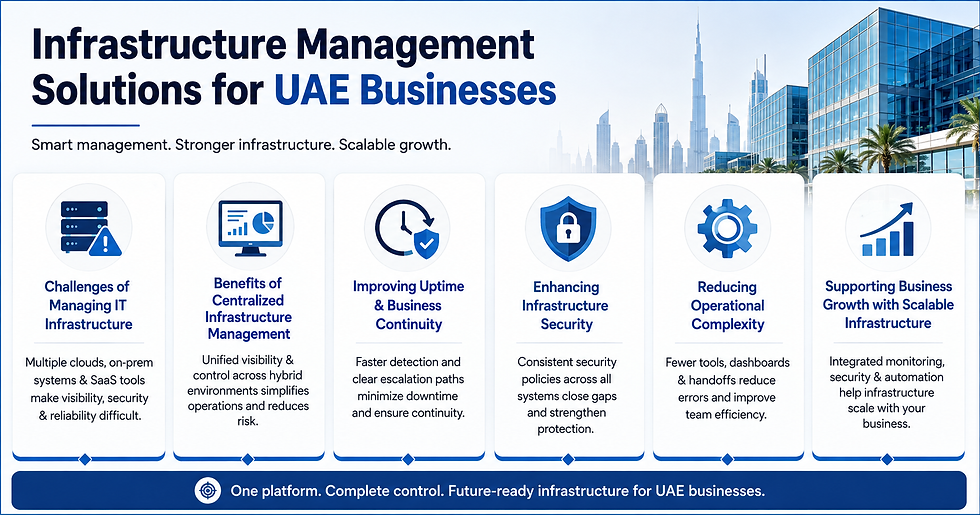
Challenges of managing modern IT infrastructure
Modern environments span multiple cloud providers, on-premises systems, and a growing set of SaaS tools — each with its own management console, its own security model, and its own way of failing. Keeping a coherent picture across all of it is one of the hardest operational problems in IT today.
Benefits of centralized infrastructure management
Centralizing visibility and control — even across a hybrid environment — turns a fragmented set of systems into something a small team can actually operate confidently. It also closes the gaps that attackers and outages tend to exploit: the systems nobody was really watching.
Improving uptime and business continuity
Centralized monitoring with clear escalation paths cuts the time between a problem occurring and someone actually responding to it, which is usually the biggest factor in how much downtime a company actually experiences.
Enhancing infrastructure security
A single, consistent security policy applied across all environments is far harder to circumvent than patchwork rules that differ by system or team.
Reducing operational complexity
Fewer tools, fewer dashboards, and fewer manual handoffs between teams means fewer places for something to fall through the cracks.
Supporting business growth with scalable infrastructure
Comprehensive infrastructure management solutions Dubai businesses adopt typically combine monitoring, security, and automation into one coordinated service, so infrastructure scales with the business instead of becoming the constraint on it.
7. Remote Infrastructure Management for Dubai-Based Businesses
What is remote infrastructure management?
Remote infrastructure management (RIM) is the practice of monitoring, maintaining, and troubleshooting IT infrastructure — servers, networks, cloud environments — from an offsite location, using remote monitoring tools rather than requiring an engineer physically present at each site.
How remote monitoring and management works
Agents installed across servers, network devices, and cloud environments feed performance and health data into a central monitoring platform, where automated alerts and human engineers respond to anomalies in real time, regardless of where the infrastructure physically sits.
24/7 infrastructure monitoring
Continuous monitoring across time zones means an issue that surfaces at 2am gets caught and triaged immediately, not discovered the next morning when someone checks a dashboard.
Remote troubleshooting and incident response
Most infrastructure issues can be diagnosed and resolved remotely — configuration errors, resource exhaustion, failed services — without needing physical access to hardware, which sharply cuts response time compared to dispatch-based support models.
Benefits for distributed and multi-location businesses
For companies operating across multiple UAE emirates or with regional offices elsewhere in the GCC, remote management means consistent monitoring and response standards everywhere, instead of infrastructure quality varying by which office happens to have strong local IT support.
Reducing downtime and IT operational costs
Remote management removes the cost and delay of dispatching engineers on-site for issues that don't actually require it, while catching problems earlier through continuous monitoring rather than periodic manual checks. This is exactly the gap that remote infrastructure management solutions in Dubai are built to close for growing, distributed organizations.
8. Best Practices for Cloud Infrastructure Management
Implement proactive monitoring. Catch anomalies before they become incidents, not after a customer complains.
Automate repetitive infrastructure tasks. Manual provisioning and patching don't scale, and they're where human error creeps in.
Follow least-privilege security principles. Every account and system should have exactly the access it needs — no more.
Maintain regular backups. And test the restore process on a schedule, not just when something breaks.
Establish disaster recovery procedures. Document them, and actually run the drill at least once a year.
Optimize cloud resources and costs. Review usage monthly, not annually — costs drift fast.
Keep infrastructure documentation updated. Undocumented infrastructure becomes a liability the moment the person who built it leaves.
Regularly review performance and capacity. Plan ahead of growth, not in response to it.
Implement governance and compliance controls. Consistent policy enforcement across every environment, not just the ones under close watch.
9. Cloud Security and Compliance Best Practices
Identity and access management. Multi-factor authentication and role-based access control should be the default, not an optional add-on, for every account with access to production systems.
Data encryption. Encrypt data at rest and in transit as standard practice — the cost of implementing it is trivial compared to the cost of a breach involving unencrypted data.
Network security. Segmentation, firewalls, and properly configured security groups limit how far an attacker can move if they get past the first layer of defense.
Security monitoring and threat detection. Automated detection tools flag unusual behavior — an account logging in from an unexpected location, a sudden spike in data egress — faster than a human reviewing logs manually ever could.
Vulnerability management. Regular scanning and a defined patching cadence close known vulnerabilities before they're exploited, rather than after.
Compliance considerations for UAE businesses. Organizations operating in the UAE need to account for local data protection regulations alongside sector-specific requirements — financial services and healthcare in particular carry additional obligations around where data is stored and how it's accessed.
Regular security audits and assessments. Point-in-time compliance isn't the same as ongoing security. Scheduled audits catch the configuration drift that happens between them.
10. Cloud Cost and Performance Optimization
Right-sizing cloud resources. Most cloud environments are over-provisioned by default — matching instance size to actual usage, rather than the size chosen at launch, is usually the single biggest lever for cost reduction.
Eliminating unused resources. Orphaned volumes, unattached IPs, and forgotten test environments quietly add up on every monthly bill.
Monitoring cloud usage. Ongoing visibility into what's actually consuming spend, broken down by team or project, makes cost accountable instead of abstract.
Automating resource scaling. Scale up during demand spikes and back down afterward, automatically — paying for peak capacity around the clock is one of the most common and avoidable cloud costs.
Establishing cost governance. Budgets, alerts, and approval workflows for provisioning keep spend predictable instead of discovered after the fact on an invoice.
Balancing performance, availability, and cost. These three pull against each other. The goal isn't to maximize any one of them — it's to find the combination that actually matches what the business needs.
11. Choosing the Right Cloud Infrastructure Management Partner
Not every provider offering "cloud management" delivers the same depth of service. Before signing a contract, evaluate against these criteria:
Technical expertise and certifications — verified experience with the specific cloud platforms your business runs on, not just general IT credentials.
Managed service capabilities — full-scope coverage of monitoring, security, backup, and optimization, rather than piecemeal support.
Security and compliance expertise — familiarity with UAE-specific regulatory requirements, not just generic best practices.
24/7 monitoring and support — with a real, tested escalation process behind it, not just a claim on the website.
Scalability — the ability to support the business at 2x or 10x its current size without a service redesign.
SLA and response times — clearly defined, contractually binding, and matched to how critical each system actually is.
Experience with UAE businesses — familiarity with local regulatory and operational context shortens the learning curve significantly.
Transparent pricing and reporting — predictable costs and clear visibility into what's being delivered, not a black box invoice.
Cloud management is often just one piece of a broader operational picture. Many UAE organizations pair it with wider IT infrastructure management solutions UAE businesses rely on for networking, hardware, and on-premises systems that sit alongside the cloud environment.
12. Conclusion
Well-managed cloud infrastructure is what turns cloud adoption from a cost center into an actual advantage. The businesses getting real value from the cloud aren't the ones with the most sophisticated architecture on paper — they're the ones that pair scalable design with proactive monitoring, disciplined security, and ongoing cost control.
Get those three things right, and infrastructure stops being a risk the business has to manage around, and becomes something that supports growth instead of limiting it.
If your current setup feels more reactive than proactive, that's usually the clearest sign it's time to bring in dedicated cloud infrastructure management support rather than continuing to patch things internally on an ad hoc basis.


Comments