Why UAE Is Becoming a Global Hub for eCommerce Logistics
Introduction
The UAE has rapidly evolved from a traditional trade center into one of the most important eCommerce logistics hubs in the world. Its strategic location between Asia, Europe, and Africa allows businesses to move products faster across international markets, making it an ideal base for fulfillment and distribution operations.
At the same time, online shopping demand across the Middle East is growing quickly, and customers now expect faster deliveries, real-time tracking, and smooth order experiences. To keep up with these expectations, logistics companies in the UAE are heavily investing in automation, AI-driven operations, and smarter supply chain systems.
This shift is also pushing businesses toward advanced UAE eCommerce logistics software solutions that help manage inventory, deliveries, and warehouse operations more efficiently. As a result, global brands, retailers, and marketplaces are increasingly choosing the UAE as a strategic logistics gateway for regional and international expansion.
Strategic Geographic Location Gives the UAE a Natural Advantage
One of the biggest reasons the UAE is becoming a global eCommerce logistics hub is its strategic location. Positioned between Asia, Europe, and Africa, the country gives businesses faster access to some of the world’s largest consumer and manufacturing markets. For eCommerce brands, this means quicker shipping, smoother distribution, and better regional reach from a single location.
Dubai and Abu Dhabi play a major role in this growth. Dubai, especially, has become a key center for cross-border trade because of its strong port connectivity, international airports, and advanced logistics infrastructure. Products coming from Asian manufacturing markets can easily move through the UAE and reach customers across the Middle East, Africa, and even Europe in less time compared to many nearby regions.
The UAE also benefits from highly developed ports and air cargo systems. Jebel Ali Port and major cargo airports help businesses handle high-volume shipments efficiently, which is extremely important for modern eCommerce operations where fast delivery has become a customer expectation rather than a bonus.
Compared to other GCC countries, the UAE still holds a stronger advantage in global logistics readiness.
Logistics Factor | UAE | Other GCC Markets |
Global Connectivity | Strong | Moderate |
Port Infrastructure | Advanced | Developing |
Cross-Border Trade Access | High | Limited in Some Regions |
eCommerce Fulfillment Readiness | Mature | Growing |
Another reason international sellers prefer the UAE is its ability to support centralized fulfillment. Instead of operating warehouses in multiple countries, many brands use the UAE as a regional distribution hub to manage inventory and deliveries more efficiently.
As logistics operations become more complex, many companies are also investing in smarter digital systems like UAE eCommerce logistics software to improve shipment tracking, inventory visibility, and warehouse coordination across regions.
Explosive Growth of eCommerce in the Middle East
The Middle East has quickly become one of the fastest-growing eCommerce markets, with the UAE leading the transformation. More consumers across GCC countries are now comfortable shopping online for everything from fashion and electronics to groceries and beauty products. This shift is being driven by high smartphone usage, better internet access, and growing trust in digital payments.
Mobile commerce is also changing how businesses operate. Customers expect smooth shopping experiences, instant payments, live order tracking, and faster deliveries directly from their phones. As online orders increase, logistics companies are under pressure to manage inventory, fulfillment, and delivery operations more efficiently. This is why many businesses are investing in scalable UAE eCommerce logistics software to streamline operations and improve customer experience.
The expansion of platforms like Amazon UAE and Noon has raised delivery standards even higher. Same-day and next-day delivery are no longer premium services — they are becoming customer expectations. To meet this demand, companies are shifting toward micro-fulfillment centers, smart warehouses, and AI-driven logistics systems that can process orders faster and reduce delays.
At the same time, the rise of D2C brands in the region is creating new logistics challenges. Unlike traditional retailers, D2C businesses rely heavily on fast fulfillment and smooth delivery experiences to retain customers. Many growing brands eventually partner with a logistics software development company or a custom software development company to build systems that match their operational needs instead of relying on generic tools.
Consumer behavior is also reshaping warehouse operations across the UAE. Businesses are moving away from traditional storage-focused warehouses and adopting faster, technology-driven fulfillment models. Companies exploring AI warehouse cost reduction UAE logistics companies solutions are using automation and predictive analytics to lower operational costs while improving delivery efficiency.
Today, strong logistics infrastructure is becoming more valuable than physical storefront expansion. In the Middle East’s competitive eCommerce market, businesses that can deliver faster, manage inventory better, and scale operations efficiently are gaining a clear advantage.

Government Support and Policies Accelerating Logistics Innovation
One of the biggest reasons the UAE is growing as an eCommerce logistics hub is strong government support. The country has spent years building a business-friendly environment focused on smart trade, faster shipping, and digital transformation.
The UAE government is actively investing in smart ports, AI-driven logistics systems, automated customs processes, and modern warehouse infrastructure. These initiatives help logistics companies reduce delays, improve delivery speed, and manage operations more efficiently.
Free zones have also played a major role in attracting international eCommerce and logistics businesses. They offer benefits like simplified licensing, tax advantages, faster customs clearance, and easier access to warehousing facilities. For global brands, this makes regional expansion much smoother and less complicated.
For example, many international sellers entering the Middle East now use UAE free zones to set up regional fulfillment centers instead of managing shipments directly from overseas. This helps them reduce delivery times across GCC markets while improving inventory control.
The UAE’s investor-friendly policies are another reason global companies continue expanding their logistics operations here. Businesses can establish operations faster compared to many other regional markets, which lowers operational friction and reduces expansion risk.
At the same time, the country’s push toward digital logistics is increasing demand for advanced solutions like UAE eCommerce logistics software that can support automation, inventory visibility, and scalable fulfillment operations.
Many businesses are also partnering with a logistics software development company or a custom software development company to build tailored logistics systems that match their operational needs.
The growing focus on automation and AI is also helping support AI warehouse cost reduction UAE logistics companies, especially as fulfillment businesses look for smarter ways to improve efficiency and reduce operational costs.
5. The Role of Advanced Technology in UAE Logistics Growth
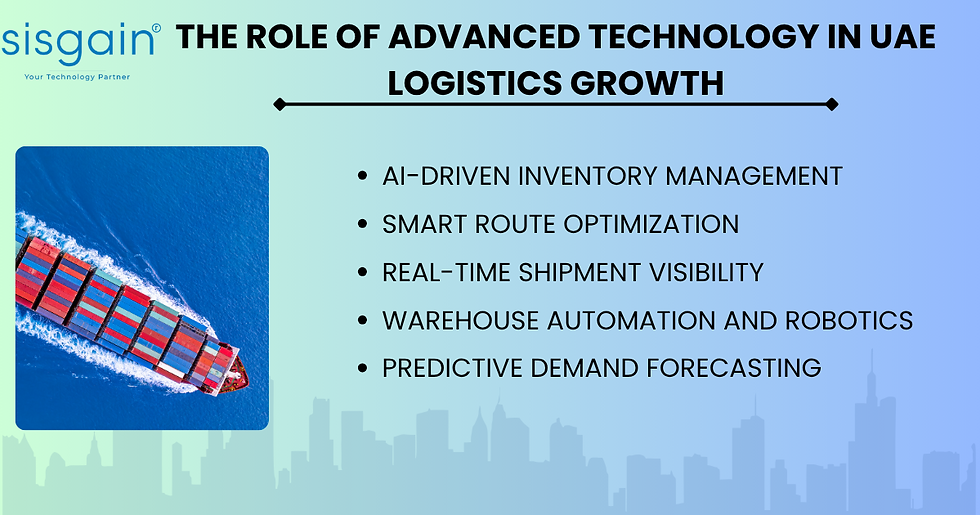
Technology is becoming one of the biggest reasons behind the rapid growth of eCommerce logistics in the UAE. As online shopping demand increases across the Middle East, logistics companies are under pressure to deliver faster, manage inventory better, and reduce operational costs at the same time.
This shift is pushing businesses away from traditional manual operations toward smarter and more connected logistics systems.
AI-Driven Inventory Management
Managing inventory manually is no longer practical for growing eCommerce businesses. Even small inventory errors can lead to delayed deliveries, overstocking, or lost sales.
AI-powered inventory systems help logistics companies:
Track stock levels in real time
Predict future demand
Reduce inventory waste
Avoid stock shortages during peak seasons
This becomes especially useful during high-demand periods like Ramadan sales or White Friday, where sudden order spikes can create operational pressure.
Smart Route Optimization
Last-mile delivery is one of the most expensive parts of logistics operations. Delays, fuel costs, and inefficient delivery routes directly impact profitability.
Smart route optimization tools use real-time traffic and delivery data to improve delivery planning. This helps businesses:
Reduce delivery time
Lower fuel consumption
Improve fleet efficiency
Handle more deliveries without increasing costs
For logistics companies managing large shipment volumes daily, even small route improvements can create major cost savings.
Real-Time Shipment Visibility
Today’s customers expect full transparency after placing an order. Businesses also need better visibility across the supply chain to avoid delays and operational confusion.
Real-time tracking systems allow logistics teams to monitor shipments at every stage. This improves coordination between warehouses, drivers, and customer support teams.
To build more scalable operations, many businesses are now working with a logistics software development company to create centralized logistics platforms that connect inventory, warehousing, and delivery management in one system.
Warehouse Automation and Robotics
Warehouse automation is helping UAE logistics companies process orders faster and more accurately. Instead of relying heavily on manual workflows, businesses are using:
Automated sorting systems
Barcode scanning
Smart picking technologies
Robotics for repetitive warehouse tasks
This improves operational speed while reducing human errors, especially during seasonal demand spikes when fulfillment centers handle large order volumes.
Predictive Demand Forecasting
One major challenge in logistics is preparing for sudden changes in demand. Predictive analytics helps businesses forecast order volumes using historical data and customer behavior patterns.
This allows logistics providers to:
Plan warehouse capacity better
Manage staffing efficiently
Reduce operational disruptions
Improve fulfillment scalability
Businesses investing in UAE eCommerce logistics software are increasingly using predictive forecasting to make faster and more accurate operational decisions.
Why Businesses Are Moving Away From Manual Operations
Many logistics companies still use disconnected systems, spreadsheets, and manual reporting processes. As operations grow, these outdated methods create serious inefficiencies such as:
Inventory mismatches
Delayed order processing
Poor shipment visibility
Higher operational costs
To stay competitive, logistics providers are shifting toward integrated digital ecosystems that connect warehousing, transportation, analytics, and fulfillment operations together.
This transformation is becoming essential for businesses that want to scale efficiently in the UAE’s fast-growing eCommerce market.
6. How AI Is Helping UAE Logistics Companies Reduce Costs

As eCommerce demand continues to grow in the UAE, logistics companies are under constant pressure to deliver faster while controlling operational costs. Managing warehouses, deliveries, inventory, and customer expectations manually is becoming difficult, especially for businesses handling large order volumes daily.
This is where AI is making a real difference.
Instead of increasing manpower and operational expenses, many logistics companies are using AI to improve efficiency, reduce waste, and make smarter decisions across their supply chain operations.
Fuel Optimization Using AI
Fuel costs are one of the biggest expenses in logistics operations. AI-powered route optimization helps companies reduce unnecessary fuel usage by analyzing:
Traffic conditions
Delivery locations
Driver routes
Peak delivery timings
This allows delivery teams to avoid delays, reduce idle time, and complete more deliveries in less time. For UAE logistics businesses handling last-mile delivery operations, even small route improvements can save significant operational costs over time.
Reducing Warehouse Waste and Overstocking
Warehouse inefficiencies often lead to higher storage costs and inventory losses. AI helps companies predict demand more accurately by studying customer buying patterns and sales trends.
This improves:
Inventory planning
Stock management
Warehouse space utilization
Order processing speed
Many businesses focusing on AI warehouse cost reduction UAE logistics companies strategies are investing in predictive inventory systems to avoid overstocking and reduce operational waste.
Smart Workforce Allocation
Order volumes in eCommerce change constantly during sales seasons, promotions, and holidays. AI helps logistics companies manage workforce planning more efficiently by predicting operational demand in advance.
This helps businesses:
Reduce overtime expenses
Improve staff productivity
Avoid operational bottlenecks
Handle peak order volumes more efficiently
For growing fulfillment companies, smarter workforce allocation directly improves profitability.
Delivery Route Prediction
Last-mile delivery is one of the most challenging parts of eCommerce logistics. AI helps improve delivery performance by predicting delays and automatically adjusting delivery routes in real time.
This leads to:
Faster deliveries
Lower transportation costs
Better delivery success rates
Improved customer experience
In competitive UAE markets, delivery speed has become a major factor in customer satisfaction.
Automated Customer Communication
Handling thousands of customer queries manually can slow down logistics operations. AI-powered systems now automate:
Delivery updates
Tracking notifications
Delay alerts
Customer support requests
This reduces support workload while improving communication with customers throughout the delivery process.
Case Study: How a UAE Fulfillment Company Reduced Costs by 30% Using AI
A mid-sized fulfillment company in the UAE was facing rising fuel expenses, delayed deliveries, and warehouse inefficiencies as order volumes increased.
To improve operations, the company implemented:
AI-powered route optimization
Predictive inventory management
Smart workforce scheduling
Automated customer communication systems
They also partnered with a logistics software development company to customize their operational workflows and integrate their systems more efficiently.
Results Achieved
Within one year, the company achieved:
30% lower operational costs
Faster order processing
Reduced fuel consumption
Better warehouse accuracy
Improved delivery performance
The company later expanded its digital infrastructure further with support from a custom software development company to scale operations more efficiently as demand continued growing.
The biggest takeaway was simple: businesses that combine AI with well-structured logistics operations gain a major competitive advantage in the UAE’s fast-growing eCommerce market.
Rise of Third-Party Logistics (3PL) Companies in the UAE
As eCommerce continues growing in the UAE, more brands are shifting towards third-party logistics (3PL) providers instead of managing logistics on their own. The reason is simple — customer expectations are changing fast, and handling fulfillment internally is becoming expensive and difficult to scale.
Today, customers expect fast delivery, real-time tracking, and smooth returns. For many eCommerce businesses, especially startups and mid-sized brands, building warehouses, managing inventory, and running delivery operations internally can slow down growth. This is where 3PL companies are playing a major role.
Instead of investing heavily in logistics infrastructure, brands are outsourcing fulfillment and warehousing to specialized providers that already have the systems, storage facilities, and delivery networks in place.
Why eCommerce Brands Prefer 3PL Providers
3PL companies help businesses reduce operational pressure while improving delivery performance. Rather than spending time managing logistics, brands can focus more on sales, customer experience, and expansion.
Some major advantages include:
Lower warehouse and operational costs
Faster order fulfillment
Better delivery management
Easier expansion across GCC markets
Improved inventory handling during peak seasons
This model is especially useful for growing businesses that need flexibility without taking on high operational risk.
Many logistics providers are also investing in advanced technology and partnering with a logistics software development company to improve warehouse automation, inventory visibility, and shipment tracking.
Flexibility Matters More Than Ownership
One of the biggest reasons behind the growth of 3PL services in the UAE is scalability.
During major sales periods or seasonal demand spikes, order volumes can increase very quickly. Businesses managing logistics internally often struggle with delays, staffing issues, and warehouse limitations.
3PL providers already operate large fulfillment networks, which allows brands to scale operations much faster without major infrastructure investment.
This is why many eCommerce businesses are now adopting asset-light models instead of building everything internally.
Last-Mile Delivery Is Now a Competitive Advantage
In the UAE market, fast delivery has become a key part of customer experience.
3PL companies are improving last-mile delivery through:
Route optimization
Real-time shipment tracking
Automated dispatch systems
Faster returns handling
Many providers are also using intelligent systems focused on AI warehouse cost reduction UAE logistics companies are increasingly adopting to improve operational efficiency and reduce fulfillment costs.
Reverse Logistics Is Becoming Equally Important
Returns management has become a major challenge for eCommerce businesses. Customers now expect quick exchanges and hassle-free refunds.
3PL providers help brands manage:
Product returns
Exchange processing
Inventory reallocation
Reverse shipping operations
A strong reverse logistics process not only improves customer trust but also helps businesses reduce operational waste.
In-House Logistics vs 3PL in UAE
Factor | In-House Logistics | 3PL Providers |
Cost | High setup and operational costs | Lower upfront investment |
Scalability | Limited by internal capacity | Easier and faster expansion |
Technology Access | Requires separate investment | Ready-to-use systems |
Delivery Efficiency | Depends on internal operations | Optimized delivery networks |
Risk Management | Higher operational burden | Shared operational responsibility |
For many startups and mid-sized brands, outsourcing logistics is becoming a smarter long-term strategy. It reduces operational complexity, improves flexibility, and gives businesses access to advanced logistics infrastructure without massive investment.
At the same time, the demand for scalable UAE eCommerce logistics software is also increasing as companies look for better visibility, automation, and operational control across their supply chain.
Market Gaps Still Existing in UAE eCommerce Logistics
The UAE has built a strong reputation in eCommerce logistics, but there are still several gaps that businesses are trying to overcome as the market grows faster. For logistics companies, these challenges are not small operational issues anymore — they directly affect delivery speed, customer experience, and profitability.
High Last-Mile Delivery Costs
Last-mile delivery is still one of the biggest cost challenges in the UAE, especially outside major cities like Dubai and Abu Dhabi. Many companies struggle with:
Rising fuel costs
Inefficient delivery routes
Delayed shipments in low-density areas
High demand for same-day delivery
As customer expectations continue to rise, logistics businesses need smarter delivery systems to maintain both speed and profitability.
Challenges in Rural Fulfillment
Urban logistics infrastructure in the UAE is strong, but rural and remote deliveries remain difficult. Many logistics providers still face:
Longer delivery timelines
Limited fulfillment coverage
Poor route optimization
Higher operational costs in outer regions
This is pushing businesses to invest in more scalable and technology-driven logistics operations.
Lack of Unified Logistics Systems
A major issue in the UAE logistics sector is disconnected operational systems. Warehousing, inventory, shipping, and customer tracking are often handled through separate platforms that do not work smoothly together.
This creates problems like:
Inventory mismatches
Delayed order processing
Limited shipment visibility
Manual operational work
To solve this, many businesses are now working with a custom software development company to build centralized logistics systems tailored to their workflows instead of relying only on generic tools.
Reverse Logistics Still Needs Improvement
Returns management is becoming a major challenge for eCommerce brands in the UAE. While deliveries are improving, reverse logistics processes are still slow and inefficient in many cases.
Common issues include:
Delayed refund processing
Poor return tracking
Warehouse congestion
Manual returns handling
For logistics companies, improving reverse logistics is becoming just as important as improving delivery speed.
Shortage of Logistics Tech Talent
As logistics operations become more digital, companies are also facing a shortage of professionals skilled in:
Warehouse automation
AI-based logistics systems
Supply chain analytics
Logistics software integrations
Many companies have the infrastructure but lack the technical expertise needed to fully optimize operations.
Why Off-the-Shelf Software Is No Longer Enough
Many ready-made logistics tools work well in the early stages, but they often fail when operations become more complex. Growing logistics businesses usually need:
Multi-warehouse management
Real-time inventory visibility
Marketplace integrations
Custom delivery workflows
This is why many UAE businesses are now investing in tailored digital solutions and partnering with a logistics software development company to build systems that support long-term scalability and operational efficiency.
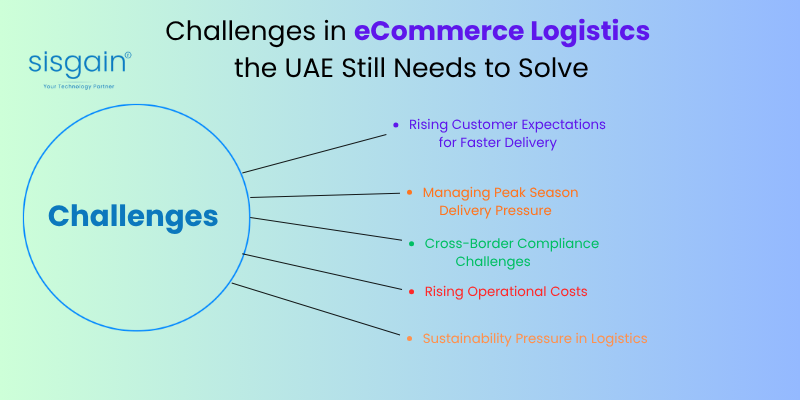
Challenges in eCommerce Logistics the UAE Still Needs to Solve
The UAE has become one of the fastest-growing eCommerce logistics markets in the Middle East, but rapid growth also comes with operational challenges. As online shopping demand increases, logistics companies are under constant pressure to deliver faster, manage costs, and maintain smooth operations at scale.
Rising Customer Expectations for Faster Delivery
Customers in the UAE now expect same-day or next-day delivery as a standard service. They also want real-time tracking, accurate delivery updates, and hassle-free returns.
This creates pressure on logistics companies to improve:
Warehouse speed
Delivery coordination
Inventory accuracy
Last-mile operations
Even small delays can affect customer trust and brand reputation. That is why many businesses are investing in advanced UAE eCommerce logistics software to automate operations and improve fulfillment visibility.
Managing Peak Season Delivery Pressure
During major sales periods like Ramadan and White Friday, order volumes increase rapidly. Many logistics companies struggle to maintain delivery efficiency during these high-demand periods.
Common problems include:
Warehouse congestion
Delayed dispatching
Inventory mismatches
Delivery backlogs
Businesses using disconnected systems often face the biggest operational slowdowns. Working with an experienced logistics software development company helps companies build scalable systems that can handle seasonal demand more efficiently.
Cross-Border Compliance Challenges
The UAE plays a major role in international trade, but cross-border logistics can still be complicated. Different countries have different customs rules, tax regulations, and shipping requirements.
Without proper systems in place, businesses often face:
Shipment delays
Documentation errors
Compliance risks
Higher operational costs
Many growing logistics providers now partner with a custom software development company to create centralized systems that simplify international shipping operations.
Rising Operational Costs
Logistics companies are also dealing with increasing fuel costs, warehouse expenses, labor costs, and last-mile delivery charges. At the same time, customers still expect faster and cheaper shipping.
This puts pressure on profitability, especially for companies relying heavily on manual processes.
To reduce operational waste, many businesses are adopting AI-driven solutions focused on AI warehouse cost reduction UAE logistics companies are actively implementing to improve warehouse efficiency and route optimization.
Sustainability Pressure in Logistics
Sustainability is becoming an important focus in the UAE logistics sector. Businesses are expected to reduce fuel consumption, delivery emissions, and packaging waste while maintaining fast delivery performance.
However, sustainability is not only about using electric vehicles. It also depends on:
Smarter route planning
Efficient warehouse operations
Better inventory management
Reduced delivery failures
Companies that improve operational efficiency naturally move toward more sustainable logistics models.
What Slows Down Logistics Scalability?
Many logistics companies grow quickly in the beginning, but scaling operations efficiently becomes difficult when internal systems are not properly structured.
Fragmented Systems
Using multiple disconnected platforms for inventory, delivery, and warehouse management creates operational confusion.
This often leads to:
Delayed reporting
Order errors
Poor visibility
Slow decision-making
Manual Warehouse Processes
Many warehouses still depend heavily on manual work for picking, packing, and inventory tracking.
This increases:
Human errors
Processing delays
Labor dependency
Fulfillment inefficiencies
Poor Inventory Visibility
Without real-time inventory tracking, businesses struggle to manage stock accurately across different sales channels and warehouse locations.
This can result in:
Stock shortages
Overselling
Delayed deliveries
Customer dissatisfaction
Delivery Coordination Issues
Last-mile delivery remains one of the biggest logistics challenges. Poor coordination between warehouses, drivers, and customers often causes delays and failed deliveries.
Common issues include:
Inefficient route planning
Communication gaps
Delayed delivery updates
Limited shipment tracking
Why Technology Alone Is Not Enough
Many companies believe that simply adding new software will solve operational problems. In reality, technology only works when logistics processes are properly organized.
If warehouse workflows are inefficient, even advanced tools cannot fully solve delivery delays or inventory issues.
Long-term scalability requires:
Better operational planning
Process optimization
Team coordination
Smart automation
Scalable digital infrastructure
The companies growing successfully in the UAE logistics market are not only investing in technology but also improving the way their operations work internally.
Why the UAE Is Outperforming Other Regional Logistics Markets
The UAE has positioned itself as the leading eCommerce logistics hub in the GCC, not just because of its location, but because of how quickly it adapts to modern logistics demands. While many regional markets are still developing their infrastructure and digital capabilities, the UAE already offers a more connected and scalable logistics ecosystem for global businesses.
Factor | UAE | Other GCC Markets |
Port Connectivity | Strong global access | Moderate |
Air Cargo Infrastructure | Advanced and fast-moving | Developing |
Technology Adoption | High | Medium |
Free Zone Benefits | Extensive business advantages | Limited |
Cross-Border Accessibility | Faster regional distribution | Slower processes |
One of the biggest advantages the UAE has is speed. Businesses can move products across Asia, Africa, and the Middle East much faster because of its strong port and air cargo network. For eCommerce companies, this directly impacts delivery timelines and customer satisfaction.
The UAE is also ahead in logistics technology adoption. Many companies are already investing in warehouse automation, AI-driven inventory tracking, and smart fulfillment systems to improve operational efficiency. This is where solutions like UAE eCommerce logistics software are becoming increasingly important for managing complex logistics operations at scale.
Another reason global brands prefer the UAE is its business-friendly environment. Free zones, simplified customs processes, and better international trade support make expansion easier for eCommerce companies entering the Middle East market.
Many logistics providers are also working with a logistics software development company to build systems that improve shipment visibility, warehouse coordination, and delivery management. As operations grow, businesses often need tailored solutions, which is why partnering with a custom software development company becomes important for handling unique supply chain workflows.
The UAE is also seeing rapid adoption of AI in logistics operations. Many enterprises are focusing on AI warehouse cost reduction UAE logistics companies strategies to lower storage costs, optimize labor usage, and improve warehouse efficiency during high-demand periods.
Why Global eCommerce Brands Choose UAE-Based Fulfillment
Instead of managing separate fulfillment centers across multiple GCC countries, many international businesses use the UAE as a centralized logistics hub. It helps them:
Reduce operational complexity
Speed up regional deliveries
Improve inventory management
Scale faster across Middle Eastern markets
For modern eCommerce businesses, the UAE is no longer just a shipping destination. It has become a technology-driven logistics ecosystem built for long-term regional growth.
Real-World Examples of Global Brands Expanding Logistics Operations in the UAE

Case Study: How a UAE-Based eCommerce Brand Improved Fulfillment Operations
The Problem
A growing eCommerce retailer in the GCC region struggled with delayed deliveries, inventory mismatches, and rising warehouse costs during peak sales periods. Their operations depended heavily on manual coordination, which slowed down fulfillment speed.
The Logistics Strategy
The company centralized its inventory in a UAE fulfillment center and partnered with regional 3PL providers to improve cross-border delivery operations.
This helped them:
Reduce delivery delays
Simplify inventory management
Improve order accuracy
Technology Implementation
To improve operational efficiency, the company implemented:
AI-based inventory forecasting
Automated order processing
Real-time shipment visibility
Smart warehouse management systems
The business also adopted solutions focused on AI warehouse cost reduction UAE logistics companies are increasingly using to optimize storage space and reduce operational waste.
Operational Results
Within a few months, the company achieved:
Faster order fulfillment
Lower warehouse operating costs
Better inventory accuracy
Improved customer satisfaction
The case clearly shows how combining UAE logistics infrastructure with smart technology is helping businesses scale faster and operate more efficiently in the eCommerce sector.
Future Trends Shaping UAE eCommerce Logistics
The UAE’s eCommerce logistics industry is evolving much faster than many global markets. Businesses are no longer focusing only on faster deliveries. Now, the real focus is on smarter operations, lower costs, and better customer experience. This shift is pushing logistics companies toward automation, AI, and data-driven systems.
Hyperautomation in Warehouses
Warehouses in the UAE are becoming more automated to handle growing order volumes efficiently. Instead of depending heavily on manual operations, companies are using technologies that speed up fulfillment and reduce errors.
This includes:
Automated picking and packing
AI-based inventory management
Smart sorting systems
Robotics for warehouse movement
These systems help logistics providers process more orders without increasing operational costs at the same pace. Many companies are also working with a logistics software development company to build systems that fit their warehouse operations more accurately.
Drone and Autonomous Delivery Testing
The UAE is actively exploring drone and autonomous delivery solutions, especially for last-mile logistics. While this is still developing, companies are testing these technologies to improve delivery speed and reduce transportation costs.
The main goal is not just innovation. It is about building a more efficient delivery network for the future, especially in high-demand urban areas.
Sustainable Logistics Is Becoming More Important
Sustainability is becoming a serious business priority in logistics. Companies are looking for ways to reduce fuel usage, packaging waste, and overall operational emissions.
Some common initiatives include:
Electric delivery vehicles
Eco-friendly packaging
AI-based route optimization
Energy-efficient warehouses
This is also where discussions around AI warehouse cost reduction UAE logistics companies are becoming more relevant, as businesses try to balance profitability with sustainability goals.
AI-Powered Supply Chain Visibility
One major challenge in logistics is the lack of real-time visibility. Delays, inventory issues, and disconnected systems can create operational problems very quickly.
To solve this, UAE logistics companies are investing in AI-powered systems that provide:
Real-time inventory tracking
Shipment monitoring
Predictive demand forecasting
Automated alerts for delays
Many growing businesses now prefer customized solutions instead of generic platforms, which increases the demand for a custom software development company that can build tailored logistics systems.
Smart Fulfillment Ecosystems
The future of logistics is moving toward connected fulfillment ecosystems where warehouses, marketplaces, delivery systems, and customer platforms work together in real time.
With integrated UAE eCommerce logistics software, businesses can:
Manage inventory across multiple channels
Improve order accuracy
Speed up fulfillment
Reduce operational inefficiencies
This kind of connected infrastructure helps companies scale faster without losing operational control.
Predictive Logistics Will Become a Competitive Advantage
In the coming years, predictive logistics will separate leading companies from average competitors. Businesses that can predict demand, delivery delays, and inventory needs in advance will operate more efficiently and reduce unnecessary costs.
Instead of reacting to problems after they happen, companies will use data to make smarter operational decisions before issues affect fulfillment performance.
Data-Driven Decision Making Will Define the Future
Modern logistics operations generate massive amounts of data every day. The companies that know how to use this data effectively will have a strong advantage in the market.
Data-driven logistics helps businesses:
Improve delivery planning
Optimize warehouse performance
Reduce operational waste
Forecast customer demand more accurately
As the UAE continues investing in digital infrastructure and smart logistics, technology-driven operations will become the standard rather than the exception.
Why Software Will Define the Next Phase of Logistics Growth
The logistics industry in the UAE is growing fast, but growth also brings operational pressure. Managing thousands of orders, multiple warehouses, delivery timelines, and inventory updates manually is no longer practical for modern eCommerce businesses. This is why software is becoming one of the biggest drivers of logistics growth in the region.
Today, logistics companies need more than just transportation and warehouse infrastructure. They need systems that can connect operations, improve visibility, and help teams make faster decisions.
Centralized Systems Improve Operational Control
Many logistics businesses still use separate tools for inventory, warehouse management, delivery tracking, and reporting. The problem is that disconnected systems create delays, data errors, and communication gaps.
A centralized logistics system helps businesses manage everything from one platform, including:
Inventory tracking
Order management
Shipment monitoring
Warehouse operations
Reporting and analytics
This improves coordination between departments and reduces manual work. It also helps businesses respond faster when operational issues happen.
Real-Time Data Helps Companies Make Faster Decisions
In eCommerce logistics, delays and inventory mistakes can directly affect customer experience. Businesses cannot afford to wait days for reports anymore.
Real-time analytics allows logistics providers to:
Track delivery performance instantly
Monitor warehouse efficiency
Identify delays early
Reduce inventory waste
Improve order accuracy
This is one reason many companies are investing in reliable UAE eCommerce logistics software solutions that provide live operational visibility across the supply chain.
Multi-Channel Inventory Management Is Becoming Critical
Most eCommerce brands now sell through multiple channels such as marketplaces, websites, and mobile apps. Without synchronized inventory systems, businesses often face:
Overselling problems
Stock mismatches
Delayed fulfillment
Poor customer experience
Modern logistics software automatically updates inventory across all platforms in real time. This reduces errors and helps businesses maintain smooth operations during high order volumes.
ERP and Marketplace Integrations Support Scalability
As logistics operations grow, manual coordination becomes difficult. Integrated systems help automate workflows between warehouses, marketplaces, accounting systems, and shipping platforms.
With proper integrations, businesses can:
Process orders faster
Automate shipment updates
Improve reporting accuracy
Reduce repetitive tasks
Scale operations more efficiently
Many businesses now work with a specialized logistics software development company to build systems that match their operational requirements instead of relying only on generic tools.
Scaling Without Digital Infrastructure Creates Long-Term Problems
A logistics company can manage manually at a smaller level, but scaling becomes difficult without digital infrastructure. As order volumes increase, businesses usually face:
Slower fulfillment
Higher operational costs
Inventory inaccuracies
Limited shipment visibility
Customer communication gaps
Technology is no longer just a support function in logistics. It has become a core operational requirement. Companies that invest early in automation, integrations, and centralized systems will be in a much stronger position as UAE eCommerce logistics continues to expand.
Conclusion
The UAE has moved far beyond being just a regional shipping and trade center. Today, it is becoming one of the most important eCommerce logistics hubs globally, driven by strong infrastructure, business-friendly policies, and rapid technology adoption.
Several factors are contributing to this growth:
Modern ports, airports, and free zones are making cross-border trade faster and more efficient.
Government support is encouraging innovation, foreign investment, and digital transformation in the logistics sector.
Rising eCommerce demand across the Middle East is pushing businesses to improve fulfillment speed and operational efficiency.
At the same time, technology is reshaping how logistics companies operate. From warehouse automation to AI-based inventory tracking, businesses are increasingly investing in smarter systems to handle growing order volumes and customer expectations. This is where advanced UAE eCommerce logistics software is helping companies improve visibility, reduce delays, and streamline operations.
Businesses that invest early in logistics modernization are likely to gain a significant long-term advantage. Companies still relying on manual workflows and disconnected systems may struggle to scale efficiently in the coming years. Because of this, many enterprises are now partnering with a trusted logistics software development company to build more flexible and scalable logistics ecosystems.
As competition continues to grow, off-the-shelf tools are no longer enough for many logistics providers. Businesses are increasingly looking for solutions from a custom software development company that can align technology with their operational requirements.
In the end, the companies that combine operational efficiency with intelligent logistics technology will be the ones leading the next phase of eCommerce growth in the UAE.

Comments