UAE Cybersecurity Market: Size, Growth, Trends & Business Opportunities
1. Introduction
Dubai's skyline gets the headlines. What's happening underneath it — in data centers, SOCs, and government mandates — is where the real cybersecurity story is playing out.
The UAE cybersecurity market is one of the fastest-growing security markets in the Middle East, and it's growing for a reason that has nothing to do with hype. The country is digitizing faster than almost anywhere else on earth, and every new cloud workload, smart-city sensor, and fintech app is a fresh target. In 2026 alone, UAE government infrastructure has weathered daily attack volumes that tripled from roughly 200,000 to 600,000 during periods of regional tension, according to Mohammed Al Kuwaiti, Head of Cyber Security for the UAE Government.
That's not a market for cybersecurity vendors to watch from the sidelines. It's a market to build in.
This guide breaks down where the UAE cybersecurity market stands today, where it's heading through the early 2030s, and — more importantly — where the actual gaps are for a Cybersecurity Services Company Dubai looking to win new business rather than compete on price against the same twenty MSSPs everyone else is chasing.
Why cybersecurity demand is growing in Dubai and the UAE
Three forces are colliding at once:
Government mandate. The UAE's National Cyber Security Strategy (2025–2031) has shifted the country from voluntary best practice to mandatory resilience, with public-sector workloads required to migrate to IA-compliant hosting by the end of 2026.
Digital-first business models. Fintech, logistics, tourism, and real estate have all moved core operations online, and Dubai in particular leads regional spending on cloud security across finance and logistics.
A threat landscape moving faster than defenses. Attackers are weaponizing newly disclosed vulnerabilities within 48 hours in many cases — sometimes faster — leaving almost no window for slow, manual patch cycles.
Why cyber resilience matters now, not later
Resilience isn't a compliance checkbox anymore. Nearly half of the vulnerabilities actively exploited in UAE organizations are more than five years old — meaning businesses aren't mostly losing to sophisticated zero-days. They're losing to unpatched legacy systems nobody got around to fixing. That's a solvable problem, and it's exactly where a capable Cybersecurity Company Dubai partner earns its retainer.
2. UAE Cybersecurity Market Size & Growth
Current Market Size
Estimates vary by research house and methodology, but they converge on the same range: the UAE cybersecurity market sits somewhere between USD 0.9 billion and 1.45 billion as of 2026, with most credible forecasts placing it close to USD 0.91 billion in 2026, according to Mordor Intelligence. From there, the trajectory is steep — Mordor projects the market reaching USD 1.51 billion by 2031, while other research firms peg similar targets in the USD 1.07–1.29 billion range by 2029–2030.
The spread exists because different reports scope the market differently — some include hardware and telecom security spend, others focus narrowly on software and services. Either way, the direction is unmistakable: fast, sustained growth, not a temporary bump.
Market Growth Rate
Across nearly every major research house, the UAE cybersecurity market is forecast to grow at a CAGR of roughly 10–14% through the early 2030s. Mordor Intelligence puts the figure at 10.66% (2026–2031); TechSci Research estimates 12.78% (2024–2030); Verified Market Research goes as high as 13.8% (2026–2032).
That's not a rounding error between analysts. It reflects genuinely accelerating investment. Services specifically — the managed detection, incident response, and consulting side of the business — are growing faster than the overall market, at an estimated 11.23% CAGR, as more UAE organizations decide it's cheaper to outsource threat hunting than to build an in-house team from scratch.

Major Growth Drivers
None of this growth is accidental. Six forces are doing the heavy lifting:
Digital transformation initiatives — banking, retail, healthcare, and government services have all moved core processes online, expanding the attack surface every quarter.
Government Smart City projects — Dubai and Abu Dhabi's smart-infrastructure rollouts connect thousands of new endpoints, each one a potential entry point.
Cloud adoption — the UAE cloud computing market alone is projected to grow from roughly USD 12.8 billion in 2025 to over USD 45 billion by 2030, and every migrated workload needs cloud-native protection.
Fintech expansion — Dubai's VARA and Abu Dhabi's ADGM are actively regulating a booming digital-asset sector, and BFSI already accounts for close to 20% of total UAE cybersecurity spend, the largest of any vertical.
Regulatory compliance requirements — the UAE's Information Assurance Standards (Version 2), PDPL, and sector-specific rules from the Central Bank are forcing budget allocation that used to be discretionary.
Increasing cyber threats — ransomware incidents rose roughly 32% in 2024, and that trajectory hasn't slowed since.
For a cybersecurity services dubai provider, each of these drivers is a different sales conversation — a CISO worried about a smart-building rollout needs a different pitch than a fintech founder worried about VARA audits.
3. Current Cybersecurity Trends in UAE
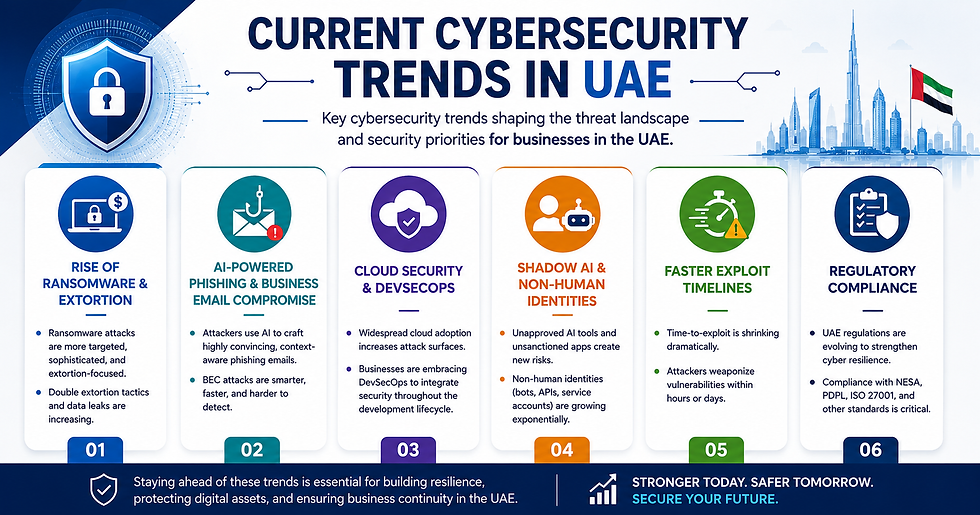
Rise of Ransomware & Extortion
Ransomware in the UAE isn't just growing — it's changing shape. Double extortion is now the default model: attackers encrypt systems and threaten to leak stolen data, which turns every incident into a regulatory and reputational crisis on top of an operational one. Groups like DragonForce and Qilin have specifically targeted UAE real estate, manufacturing, and construction firms in recent campaigns, often through exploited VPN and remote-access vulnerabilities.
Here's the number that should worry every board: nearly half of UAE organizations hit by ransomware have chosen to pay. That's not resilience — that's a market with no better option, and it's exactly why demand is surging for:
EDR/XDR platforms with behavioral detection
Incident response retainers, not just one-off engagements
Immutable, tested backup solutions built on the 3-2-1 rule
AI-Powered Phishing & Business Email Compromise
Over 75% of breaches in the UAE now originate from phishing or fraudulent messages — and the quality of those messages has changed completely. Attackers are using tools like ChatGPT and WormGPT to write phishing emails with near-perfect fluency, often tied to current events, and to generate deepfake audio and video impersonating executives.
The UAE Cyber Security Council estimates over 3.4 billion phishing messages are sent daily across the country. Businesses can't train their way out of that volume alone. Demand is shifting toward:
Identity protection and MFA enforcement
AI-aware email security that catches synthetic content, not just malicious links
Ongoing employee awareness training — not an annual slide deck
Cloud Security & DevSecOps
With UAE cloud spend expanding at close to 29% CAGR, cloud security has stopped being a nice-to-have line item and become the largest single growth pocket in the market. Government cloud-first mandates and data-residency clauses in the IA Standards mean multi-cloud environments now need security baked in at the architecture level, not bolted on after launch. That's pushing demand for secure cloud migration support, multi-cloud security posture management, DevSecOps integration, and cloud workload protection.
Shadow AI & Non-Human Identities
Here's a trend most UAE businesses haven't caught up to yet: employees quietly feeding sensitive company data into unapproved AI tools. Security teams call it "shadow AI," and it's created a governance gap almost overnight — nobody signed off on it, nobody's monitoring it, and it's happening in nearly every department.
At the same time, AI agents are increasingly granted direct access to enterprise systems and data, creating a new category of "non-human identity" that traditional identity and access management wasn't built to handle. Expect rising demand for AI governance frameworks and non-human identity management over the next 24 months.
Faster Exploit Timelines
The old assumption — that businesses have weeks to patch a disclosed vulnerability — no longer holds. SonicWall's most recent threat report found 61% of hackers now exploit new vulnerabilities within 48 hours of public disclosure. In the UAE specifically, nearly half of actively exploited vulnerabilities are more than five years old, meaning the gap isn't awareness — it's execution.
That combination — fast attackers, slow patching — is exactly what continuous monitoring, disciplined patch management, and regular VAPT (vulnerability assessment and penetration testing) engagements exist to fix.
Regulatory Compliance
The regulatory floor has risen sharply. The Central Bank of the UAE's Federal Decree-Law No. 6 of 2025, effective September 2025, overhauled financial-sector oversight with a strong focus on operational resilience and recovery planning. PDPL (Federal Decree-Law No. 45/2021) carries fines up to AED 20 million for serious violations, with full compliance required through a transition period running to January 2027.
Put simply: cyber resilience is now a legal obligation with a real price tag attached, not a best-practice recommendation. That means growing demand for governance frameworks, third-party risk management, and audit-ready compliance reporting — especially for mid-sized firms that don't have in-house legal or compliance teams.
4. Market Gaps & Opportunities for B2B Cybersecurity Providers

SME Managed Security Services
A full security stack can eat up to 12% of an SME's IT budget — enough to scare most small businesses into treating cybersecurity as a checkbox rather than a priority. That's the gap. SMEs need affordable MSSP packages, MDR bundled at a predictable monthly rate, compliance-ready service tiers, and clear SLAs. Nobody's building this well yet, and it's arguably the single largest underserved segment in the market.
Cybersecurity Talent Shortage
The UAE simply doesn't have enough senior security professionals to staff every organization that needs one — and that shortage is a direct driver of managed-services growth. Co-managed SOC models, Security-as-a-Service, and flexible staff augmentation let businesses access senior expertise without a six-figure hire. Providers that can offer "your team plus our SOC" rather than "replace your team" will win more deals, faster.
Cloud-Native Security Services
Large enterprises still hold about two-thirds of UAE cybersecurity spend, but cloud-native security — CSPM, CWPP, DevSecOps consulting, cloud hardening tied to local data-residency rules — is where the fastest growth is happening. Providers who can speak fluently to both AWS/Azure sovereign-region requirements and IA Standards compliance have a genuine differentiator.
AI Security Solutions
This is early-stage but moving fast. AI governance, non-human identity management, AI usage monitoring, and AI-specific risk assessment are all categories that barely existed as commercial offerings two years ago. First movers here are building a moat before the market matures and commoditizes.
OT/ICS Security
Abu Dhabi in particular has doubled down on operational-technology protection for energy infrastructure, and the same urgency extends to utilities, aviation, ports, and logistics. OT/ICS security requires a genuinely different skill set than IT security — and providers who've built that capability are scarce relative to demand.
Compliance Automation
Manual compliance reporting doesn't scale with the pace of new regulation. Policy-as-Code, automated compliance monitoring, audit-readiness tooling, and evidence collection are becoming must-haves for any mid-to-large enterprise navigating PDPL, IA Standards, and sector-specific rules simultaneously.
5. Go-to-Market (GTM) Strategies for Dubai & UAE

SME-Focused MDR & MSSP Packages
Lead with a fast, low-friction security assessment, then convert into 24/7 monitoring, incident response, and pre-built compliance templates. Price in clear tiers — SMEs need to see the ceiling before they'll commit.
Talent Augmentation Services
Position co-managed SOC and incident-response retainers as a bridge, not a replacement — most CISOs want to keep some control in-house. Offer project-based staffing for compliance audits and security consultants for board-level reporting.
Cloud Security Packages
Bundle CSPM, CWPP, and DevSecOps consulting with explicit UAE data-residency compliance built in. Multi-cloud security is table stakes now — the differentiator is being able to prove residency compliance in the sales conversation, not after the contract is signed.
OT/ICS Incident Response
Target critical infrastructure operators directly with nation-state-attack preparedness assessments and recovery planning — this is a relationship-driven sale, not a self-serve one, and it rewards providers with genuine sector credentials.
AI Governance Solutions
Start with an AI asset inventory offering — most enterprises don't actually know what AI tools their teams are using. From there, layer in permission management, DLP, and ongoing AI monitoring. This is a land-and-expand play, not a one-time sale.
6. Practical Next Steps for Businesses
Competitor Analysis
Before building or expanding a cybersecurity offering in the UAE, map the field honestly: who are the established MSSPs in Dubai, which VAPT providers dominate, which cloud security consultancies have the enterprise relationships already — and where are the actual gaps. SME MDR and AI governance remain comparatively open; general MSSP services are crowded.
Build an MSSP Offering
Structure clear pricing tiers, define service packages by business size rather than one-size-fits-all, build a repeatable onboarding process, and have compliance documentation ready before the first client asks for it — not after.
Incident Response Retainer
A 24/7 IR retainer needs three things to actually work under pressure: digital forensics capability, established legal coordination, and a documented regulatory reporting process for PDPL and sector-specific breach obligations. Build all three before selling the retainer, not during the first incident.
7. Why Businesses Need a Cybersecurity Partner in Dubai
The math is simple. Cyber threats in the UAE aren't slowing down — daily attack volumes have already tripled during periods of regional tension, and AI is compressing the time between vulnerability disclosure and active exploitation from weeks to hours. Regulatory compliance is no longer optional, with real financial penalties attached to PDPL, IA Standards, and Central Bank mandates. Business continuity now depends on incident response speed, not just prevention.
Building all of this in-house — SOC, compliance, incident response, cloud security — costs more and takes longer than most businesses can afford, especially with the region's ongoing talent shortage. A managed partnership solves the cost problem and the speed problem at once.
Working with an experienced Cybersecurity Services Company Dubai gives businesses access to 24/7 monitoring, compliance expertise, and incident response capability without the overhead of building it from scratch — and gives them a partner who's already fluent in UAE-specific regulation, not one learning it on the job. That's the difference between a Cybersecurity Company Dubai that just sells licenses and one that actually reduces risk.

8. Conclusion
The UAE cybersecurity market presents real, sustained growth — not a short-term bump tied to one bad headline year. Between rising attack volumes, tightening regulation, and a genuine talent shortage, demand isn't going anywhere but up through the early 2030s.
Organizations that treat security as a proactive investment, not a reactive cleanup after a breach, will be the ones still standing when the next wave of AI-driven attacks hits. Partnering with an experienced Cybersecurity Services Company Dubai can help businesses strengthen their security posture, stay ahead of regulatory compliance requirements, and protect the digital assets their entire operation now depends on.
The businesses that move now — before the next mandate, before the next breach — are the ones that get to choose their partner instead of scrambling for one.


Comments