The Truth About IT Trust and Zero Trust Security: 10 Lessons Every Business Should Learn

Cybersecurity has evolved dramatically over the past decade. Traditional security models that relied on perimeter defenses and implicit trust are no longer effective against today's sophisticated cyber threats. As organizations embrace cloud computing, remote work, mobile devices, and digital transformation, attackers have found countless new ways to infiltrate corporate networks.
This shift has made Zero Trust Security one of the most important cybersecurity strategies for modern businesses. Rather than assuming users or devices inside the network can be trusted, Zero Trust operates on the principle of "Never Trust, Always Verify."
Unfortunately, many organizations still misunderstand what Zero Trust actually means. Some believe it is simply another firewall, while others think it requires replacing every existing security tool. In reality, Zero Trust is a strategic security framework that continuously validates identities, devices, applications, and network activity before granting access.
Many organizations today are adopting Zero Trust Managed Services Dubai to implement modern security architectures that reduce cyber risks while supporting business growth. By combining identity management, continuous authentication, endpoint protection, and risk-based access controls, businesses can significantly strengthen their cybersecurity posture.
This guide explores 10 essential lessons every business should understand about Zero Trust Security and why it is quickly becoming the global standard for enterprise cybersecurity.
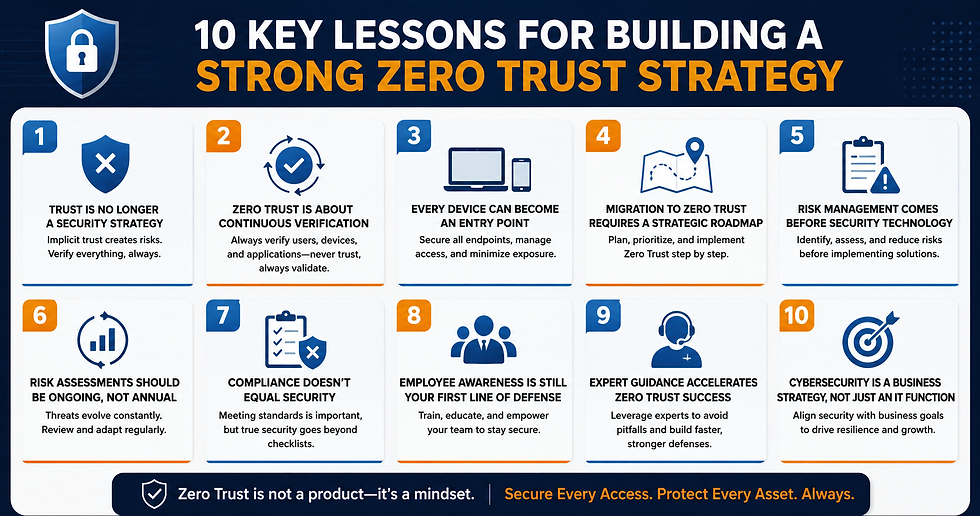
Lesson 1: Trust Is No Longer a Security Strategy
For years, organizations relied on the "trust but verify" model. Once users authenticated inside the corporate network, they often gained broad access to systems and applications.
Unfortunately, today's attackers exploit this implicit trust.
Cybercriminals no longer attack only firewalls. Instead, they compromise employee credentials, infected devices, third-party vendors, and cloud applications. Once inside the environment, they move laterally across systems looking for sensitive information.
Major ransomware attacks, supply chain breaches, and credential theft incidents demonstrate how dangerous implicit trust has become.
Zero Trust removes this assumption entirely by requiring verification for every access request, regardless of whether the request originates inside or outside the corporate network.
Lesson 2: Zero Trust Is About Continuous Verification
Zero Trust is not based on one-time authentication.
Instead, it continuously evaluates every user, device, application, and workload throughout each session.
Organizations implementing Zero Trust verify:
User identity
Device health
Location
Risk level
Authentication strength
Application behavior
Access decisions constantly adapt based on changing risk conditions.
A core principle is least privilege access, ensuring users receive only the permissions necessary to perform their responsibilities.
Many organizations work with Zero Trust Security Experts Dubai to implement continuous authentication, identity-based access control, and adaptive security policies that significantly reduce unauthorized access risks.
Lesson 3: Every Device Can Become an Entry Point
Modern workplaces use laptops, smartphones, tablets, IoT devices, cloud servers, and remote endpoints.
Every connected device expands the organization's attack surface.
Bring Your Own Device (BYOD) policies increase productivity but also introduce security challenges because personal devices often lack enterprise-grade protection.
Internet of Things (IoT) devices are another growing concern. Many operate with outdated firmware and weak authentication, making them attractive targets for attackers.
Zero Trust addresses these risks through:
Endpoint detection and response (EDR)
Device posture validation
Continuous endpoint monitoring
Conditional access policies
Device compliance verification
Only trusted and compliant devices are allowed to access sensitive business resources.
Lesson 4: Migration to Zero Trust Requires a Strategic Roadmap
One of the biggest misconceptions is that Zero Trust can be implemented overnight.
Successful deployment requires careful planning.
Organizations that rush implementation often experience operational disruptions, poor user adoption, and security gaps.
Common migration mistakes include:
Skipping asset discovery
Ignoring identity management
Poor network segmentation
Weak access governance
Lack of executive support
A phased implementation typically includes:
Assessing current infrastructure
Identifying critical assets
Strengthening identity management
Implementing MFA
Segmenting networks
Monitoring continuously
Optimizing security policies
Businesses planning this transition often leverage Zero Trust Migration Dubai services to modernize legacy environments while minimizing operational risks.

Lesson 5: Risk Management Comes Before Security Technology
Many businesses purchase cybersecurity tools before fully understanding their risks.
This approach often results in unnecessary spending and security gaps.
Effective Zero Trust begins with comprehensive risk management.
Organizations should first identify:
Critical business assets
Sensitive information
Business-critical applications
High-risk users
Third-party dependencies
Regulatory obligations
Once risks are understood, organizations can prioritize investments that deliver the greatest security value.
Many businesses rely on IT Risk Management Services Dubai to identify operational, technical, and compliance risks before implementing Zero Trust strategies.
Lesson 6: Risk Assessments Should Be Ongoing, Not Annual
Cyber threats evolve daily.
New vulnerabilities appear constantly.
Cloud services change.
Employees join and leave organizations.
Business applications expand.
Annual security assessments alone are no longer sufficient.
Zero Trust requires continuous risk assessment supported by:
Security monitoring
Threat intelligence
Vulnerability management
Automated alerts
Security analytics
Behavioral monitoring
Continuous evaluation allows organizations to respond quickly to emerging threats before attackers exploit weaknesses.
Businesses increasingly incorporate IT Risk Assessment Dubai into their ongoing cybersecurity programs to continuously identify vulnerabilities and improve resilience.
Lesson 7: Compliance Doesn't Equal Security
Many organizations mistakenly assume compliance guarantees cybersecurity.
Compliance frameworks such as:
ISO 27001
GDPR
PCI DSS
NIST
HIPAA
provide important security guidelines but do not eliminate cyber risks.
Organizations may pass compliance audits while still exposing themselves to phishing attacks, insider threats, ransomware, credential theft, or cloud misconfigurations.
Zero Trust complements compliance by continuously validating users, limiting privileges, and monitoring suspicious activities.
Instead of viewing compliance as the finish line, organizations should treat it as one component of a broader cybersecurity strategy.
Lesson 8: Employee Awareness Is Still Your First Line of Defense
Technology alone cannot prevent every cyberattack.
Human error remains one of the leading causes of data breaches.
Employees frequently become victims of:
Phishing emails
Social engineering
Credential theft
Password reuse
Business email compromise
Malicious attachments
Even the strongest Zero Trust architecture depends on informed users.
Organizations should conduct regular:
Security awareness training
Phishing simulations
Password management education
Incident reporting exercises
Remote work security training
An informed workforce dramatically reduces the likelihood of successful cyberattacks.
Lesson 9: Expert Guidance Accelerates Zero Trust Success
Implementing Zero Trust involves multiple technologies, business processes, governance models, and security frameworks.
Without experienced guidance, organizations may:
Overspend on unnecessary technologies
Misconfigure security policies
Create poor user experiences
Delay implementation
Miss critical vulnerabilities
Cybersecurity consultants help organizations design scalable Zero Trust architectures aligned with business objectives.
Organizations often engage IT Risk Consulting Dubai specialists to align cybersecurity initiatives with governance, compliance, and enterprise risk management while developing sustainable long-term security strategies.
Lesson 10: Cybersecurity Is a Business Strategy, Not Just an IT Function
Cybersecurity is no longer solely the responsibility of the IT department.
Executive leadership must actively participate in cyber risk management.
Zero Trust supports broader business objectives by improving:
Business continuity
Operational resilience
Customer trust
Regulatory compliance
Digital transformation
Competitive advantage
Organizations that integrate cybersecurity into enterprise risk management are better prepared for future threats.
Many enterprises partner with an IT Risk Management Company Dubai to embed cybersecurity into strategic planning, ensuring security investments align with organizational goals and long-term growth.
Common Myths About Zero Trust Security

Despite its growing popularity, several misconceptions continue to discourage organizations from adopting Zero Trust.
Myth 1: Zero Trust Is Only for Large Enterprises
Reality: Businesses of every size face cyber threats. Small and medium-sized organizations can implement Zero Trust principles incrementally.
Myth 2: Zero Trust Reduces Productivity
Reality: Modern identity management, adaptive authentication, and single sign-on improve both security and user experience.
Myth 3: Zero Trust Is Too Expensive
Reality: The cost of implementing Zero Trust is often far lower than the financial impact of ransomware, data breaches, regulatory penalties, and downtime.
Myth 4: Zero Trust Replaces Existing Security Tools
Reality: Zero Trust enhances existing cybersecurity investments by integrating identity management, endpoint security, cloud security, network segmentation, and monitoring into a unified framework.
How Businesses Can Start Their Zero Trust Journey
Organizations do not need to replace every security solution overnight.
Instead, they should follow a structured approach:
Assess current cybersecurity posture.
Identify critical business assets and sensitive data.
Define users, identities, and access requirements.
Implement Multi-Factor Authentication (MFA).
Apply least privilege access controls.
Segment networks to reduce lateral movement.
Continuously monitor user and device activity.
Review and improve policies based on evolving threats.
Many organizations choose Zero Trust Managed Services Dubai to simplify implementation, continuous monitoring, policy optimization, and long-term security management while allowing internal teams to focus on core business operations.

Conclusion
Traditional trust-based security models were built for a different era. Today's hybrid work environments, cloud applications, mobile devices, and increasingly sophisticated cyber threats require a more proactive approach.
The ten lessons outlined in this guide demonstrate why Zero Trust has become the foundation of modern cybersecurity. By continuously verifying identities, enforcing least privilege access, protecting endpoints, managing risks proactively, and integrating cybersecurity into business strategy, organizations can significantly reduce their exposure to evolving threats.
Whether your organization is beginning its cybersecurity transformation or strengthening an existing security framework, now is the time to evaluate your current IT security strategy. Explore Zero Trust solutions and IT risk management resources to build a resilient, future-ready security posture that supports business growth while safeguarding critical assets.


Comments