How AI Helps Financial Institutions Detect Risks and Stay Compliant
- sisgaintechnologies
- May 16
- 9 min read

Introduction
Financial institutions are facing increasing pressure to strengthen compliance and risk management processes. Rising financial fraud, cyberattacks, anti-money laundering (AML) violations, and evolving regulatory requirements have made compliance more complex than ever. Traditional compliance systems, which rely heavily on manual monitoring and rule-based processes, often struggle to detect sophisticated threats in real time.
As digital banking and online financial transactions continue to grow, banks and fintech companies need faster, smarter, and more scalable solutions to manage operational risks. This is where Artificial Intelligence (AI) is transforming the financial sector. AI-powered systems can analyze massive volumes of transaction data, identify suspicious activities, automate compliance checks, and improve risk assessment accuracy with minimal human intervention.
AI is especially valuable for detecting fraud patterns, monitoring AML risks, automating Know Your Customer (KYC) verification, and ensuring continuous regulatory compliance. Unlike conventional systems, AI models learn from historical and real-time data, enabling financial institutions to identify hidden risks before they become major compliance issues.
In the UAE, the rapid growth of digital banking and fintech innovation is accelerating the adoption of AI-driven compliance technologies. Financial organizations are investing in advanced automation tools to meet strict regulatory standards while improving operational efficiency. Businesses are increasingly partnering with a reliable software development company in UAE to build intelligent compliance platforms that support secure, scalable, and regulation-ready financial ecosystems.
Additionally, organizations offering fintech development services in UAE are helping banks and fintech startups integrate AI into fraud detection, AML monitoring, cybersecurity, and regulatory reporting systems. This shift toward intelligent automation is becoming essential for financial institutions aiming to stay compliant, reduce financial risks, and maintain customer trust in a highly regulated environment.
Understanding Risk and Compliance Challenges in Financial Institutions
Financial institutions face growing risks due to digital banking expansion, online transactions, and evolving cyber threats. Traditional compliance systems are no longer enough to detect fraud, manage risks, and meet regulatory requirements efficiently. This is why many banks and fintech companies now invest in AI-powered solutions and partner with a trusted software development company in UAE to improve compliance operations.
Major Financial Risks
Banks and financial institutions deal with several critical risks, including fraud detection, money laundering, credit risk, and cybersecurity threats. Fraudsters use advanced digital methods to perform unauthorized transactions and identity theft, making real-time monitoring essential. Financial organizations also face operational risks such as system failures and transaction anomalies that can impact customer trust and business stability.
Compliance Challenges
Managing compliance has become more difficult due to constantly changing financial regulations and complex cross-border transactions. Manual reporting processes often lead to delays and human errors during audits. KYC and AML monitoring also require continuous transaction analysis, which is difficult to manage without automation. This has increased demand for advanced fintech development services in UAE that support AI-driven compliance systems.
Why UAE Financial Institutions Need Advanced Compliance Systems
The UAE’s financial sector is rapidly adopting fintech and digital banking technologies, increasing the need for stronger compliance frameworks. Financial institutions must follow guidelines set by Central Bank of the UAE while protecting customer data and preventing fraud. As digital banking grows, businesses are increasingly investing in Digital IT Solution in UAE providers to strengthen security, automate compliance, and align with evolving fintech compliance regulations in UAE.
3. Role of AI in Financial Risk Detection
AI is helping financial institutions detect risks faster, improve security, and strengthen compliance processes. Unlike traditional systems, AI can analyze large volumes of financial data in real time, identify suspicious activities, and reduce manual monitoring efforts. Banks and fintech companies are increasingly using AI to manage fraud, AML compliance, credit risks, and cybersecurity threats more efficiently.
AI-Powered Fraud Detection
AI improves fraud detection by monitoring transactions in real time and identifying unusual customer behavior instantly. Machine learning algorithms analyze spending patterns, transaction history, and device activity to detect suspicious actions before major fraud occurs.
AI also helps reduce false positives, allowing genuine transactions to continue smoothly while flagging high-risk activities for review.
Financial institutions use AI for:
Real-time transaction monitoring
Card fraud prevention
Detecting unusual spending behavior
Transaction velocity analysis
Account takeover detection
AI in Anti-Money Laundering (AML)
AI helps financial institutions automate AML monitoring and detect suspicious transactions more accurately. Machine learning systems can identify hidden transaction patterns, shell companies, and unusual fund movements that may indicate money laundering activities.
Behavioral analytics also allows banks to monitor customer activities continuously and generate alerts automatically for high-risk transactions.
Many organizations now rely on advanced fintech development services in UAE to build automated AML and compliance solutions that improve efficiency and reduce manual workloads.
AI for Credit Risk Assessment
AI-driven credit risk models help banks evaluate borrowers more accurately by analyzing financial behavior, transaction history, and alternative data sources. Predictive analytics enables lenders to make faster loan decisions while reducing default risks.
AI improves:
Loan approval accuracy
Underwriting efficiency
Risk prediction
Customer evaluation speed
This helps financial institutions create more reliable and scalable lending systems.
Cybersecurity Risk Detection Using AI
AI strengthens financial cybersecurity by detecting threats such as phishing attacks, identity theft, and unauthorized account access in real time. AI-powered systems continuously monitor networks and user behavior to identify suspicious activities before security breaches occur.
Key benefits include:
Real-time threat detection
Automated anomaly monitoring
Phishing prevention
Account security enhancement
Many financial institutions partner with trusted Digital IT Solution in UAE providers to build secure AI-powered risk management and cybersecurity systems.
4. How AI Improves Regulatory Compliance

AI is helping financial institutions automate compliance processes, reduce manual errors, and improve risk monitoring. As financial regulations become more complex, especially under evolving fintech compliance regulations in UAE, AI enables banks and fintech companies to maintain compliance more efficiently and securely.
Automated KYC (Know Your Customer)
AI simplifies KYC verification by automating document checks, facial recognition, and biometric authentication. It helps financial institutions onboard customers faster while reducing identity fraud and manual verification work.
Many businesses use fintech development services in UAE to implement AI-powered KYC systems that improve security and customer experience.
AI in Regulatory Reporting
AI automates compliance reporting by collecting and analyzing financial data in real time. This reduces reporting delays, improves accuracy, and simplifies audit management.
A reliable software development company in UAE can help financial institutions build automated reporting systems that meet regulatory requirements efficiently.
Real-Time Compliance Monitoring
AI continuously monitors transactions and customer activities to detect suspicious behavior instantly. Automated alerts and AI-driven dashboards help compliance teams respond quickly to fraud risks and policy violations.
Financial institutions are increasingly adopting Digital IT Solution in UAE providers for advanced compliance monitoring systems.
NLP for Regulatory Updates
Natural Language Processing (NLP) helps financial institutions track changes in financial laws and compliance policies. AI can analyze legal documents and summarize important regulatory updates faster, reducing compliance risks.
This is especially important as fintech compliance regulations in UAE continue evolving alongside digital banking and fintech growth.
5. Benefits of AI in Financial Compliance and Risk Management
AI is helping financial institutions improve compliance processes, detect risks faster, and reduce operational inefficiencies. Banks and fintech companies are increasingly using AI to manage growing regulatory requirements and secure digital transactions.
Faster Risk Detection
AI systems monitor transactions in real time and instantly detect suspicious activities. This helps financial institutions prevent fraud, identify unusual behavior, and reduce compliance risks more effectively. Businesses working with a trusted software development company in UAE can implement scalable AI-powered monitoring solutions.
Reduced Operational Costs
AI automates repetitive compliance tasks such as transaction screening, KYC verification, and report generation. This reduces manual workload, lowers operational expenses, and minimizes the risk of regulatory penalties. Many firms now rely on fintech development services in UAE to improve compliance efficiency.
Improved Accuracy
AI improves accuracy by reducing human errors in fraud detection, AML monitoring, and regulatory reporting. Machine learning models analyze large datasets quickly and support better financial decision-making, especially under evolving “fintech compliance regulations in UAE.”
Better Customer Experience
AI-powered onboarding and automated verification processes make digital banking faster and more secure. Customers benefit from quick account setup and safer transactions. Financial institutions using advanced Digital IT Solution in UAE services can deliver more secure user experiences.
Scalability for Growing Financial Institutions
AI systems can handle massive transaction volumes while maintaining compliance accuracy. This scalability supports the rapid growth of digital banking and fintech services across the UAE financial sector.
6. Real Case Studies of AI in Financial Compliance and Risk Detection
Case Study: HSBC Using AI for AML Monitoring
HSBC adopted AI-powered AML systems to improve transaction monitoring and identify suspicious financial activities more accurately. Machine learning algorithms helped the bank reduce false positives by filtering low-risk alerts and prioritizing genuine threats. AI also improved the speed of AML investigations by detecting unusual transaction patterns in real time. This case shows how financial institutions use intelligent automation to strengthen compliance operations and reduce financial crime risks.
Case Study: JPMorgan Chase and AI-Based Fraud Detection
JPMorgan Chase uses AI and machine learning to monitor millions of transactions and prevent fraud. The system analyzes payment behavior, customer activity, and transaction patterns to detect suspicious actions instantly. Real-time fraud detection helps reduce financial losses while improving compliance efficiency. Many financial organizations now partner with a software development company in UAE to implement similar AI-driven risk management systems.
UAE Fintech Compliance Transformation Example
Fintech companies in the UAE are increasingly adopting AI for KYC verification and AML compliance. Automated compliance platforms help businesses verify customer identities, monitor transactions, and detect suspicious activities faster. The rise of fintech compliance regulations in UAE is driving demand for fintech development services in UAE and advanced Digital IT Solution in UAE to support secure and scalable financial operations.
Challenges of Using AI in Financial Compliance
While AI improves fraud detection and regulatory monitoring, financial institutions still face several implementation challenges. These issues can impact security, compliance efficiency, and operational performance, especially under evolving fintech compliance regulations in UAE.
Data Privacy Concerns
AI systems process large amounts of sensitive financial data, including customer identities, transactions, and banking records. Financial institutions must ensure strong cybersecurity measures, secure data storage, and proper customer consent management to avoid data breaches and compliance violations. Businesses offering fintech development services in UAE are increasingly focusing on secure AI-driven compliance solutions.
AI Bias and Decision Transparency
AI models can sometimes generate biased or inaccurate results if trained on poor-quality data. In compliance operations, this may lead to false fraud alerts or unfair customer risk assessments. Explainable AI is important because regulators and compliance teams need transparency in automated decision-making. A trusted software development company in UAE can help build more transparent and accountable AI systems.
Regulatory Uncertainty Around AI
AI regulations in the financial sector are still evolving. Many banks and fintech companies face uncertainty regarding AI governance, ethical usage, and audit requirements. Organizations using Digital IT Solution in UAE strategies must continuously update their compliance frameworks to align with changing regulations.
Integration with Legacy Banking Systems
Many banks still operate on outdated legacy systems that are difficult to integrate with modern AI technologies. Migration complexity, infrastructure upgrades, and data compatibility issues can slow down AI adoption. This is why financial institutions often partner with fintech development services in UAE providers to modernize compliance operations efficiently.
8. Future of AI in Financial Risk and Compliance
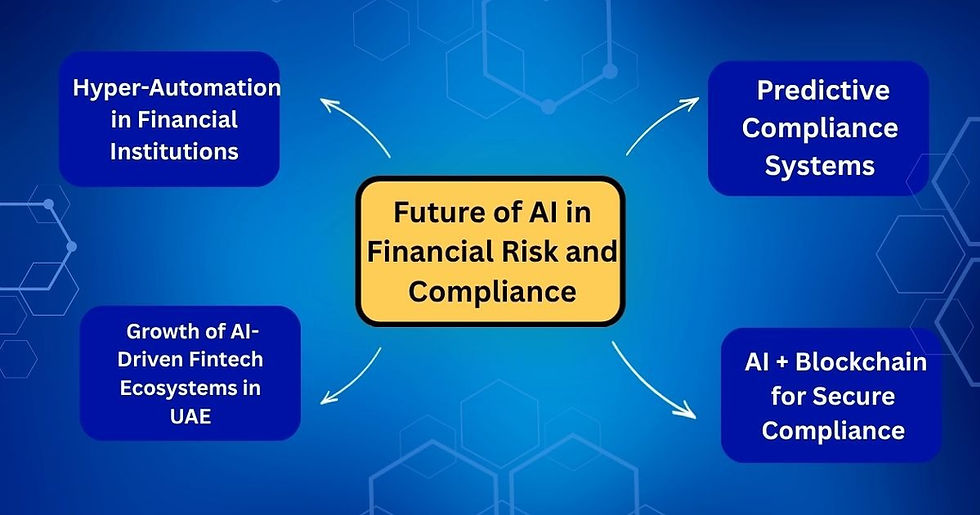
AI is reshaping how financial institutions manage compliance and detect risks. Modern banks and fintech companies are moving toward intelligent systems that can automate monitoring, improve security, and reduce regulatory violations.
Predictive Compliance Systems
Predictive AI helps financial institutions identify compliance risks before violations occur. By analyzing transaction patterns and customer behavior, AI can detect suspicious activities early and reduce regulatory penalties. This is becoming increasingly important under evolving “fintech compliance regulations in UAE.”
AI + Blockchain for Secure Compliance
AI and blockchain together improve transparency and security in financial operations. Blockchain creates secure transaction records, while AI monitors them in real time to detect fraud and compliance issues. Many businesses now work with a software development company in UAE to build secure AI-powered compliance systems.
Hyper-Automation in Financial Institutions
Hyper-automation combines AI, RPA, and analytics to automate compliance workflows. It helps banks speed up KYC checks, generate reports faster, and reduce manual errors. This also increases demand for advanced Digital IT Solution in UAE providers.
Growth of AI-Driven Fintech Ecosystems in UAE
The UAE is rapidly becoming a fintech innovation hub. Financial institutions are adopting AI for fraud detection, AML monitoring, and digital banking services. This growth is also increasing the demand for fintech development services in UAE that support secure and compliant fintech solutions.
Why UAE Financial Institutions Are Investing in AI Compliance Solutions
UAE financial institutions are investing in AI compliance solutions to manage growing regulatory demands, detect fraud faster, and improve financial security. As digital banking and fintech services expand, traditional compliance systems are becoming less effective in handling real-time monitoring and risk detection.
Government-led digital transformation initiatives and evolving fintech compliance regulations in UAE are also pushing banks and fintech companies toward AI-powered systems. These solutions help automate AML, KYC, fraud detection, and compliance reporting processes while reducing operational costs and human errors.
To stay competitive, many organizations are partnering with providers offering fintech development services in UAE and advanced Digital IT Solution in UAE capabilities. Working with a reliable software development company in UAE helps financial institutions build scalable, secure, and future-ready compliance systems.
Why Choose SISGAIN for AI-Powered Fintech Compliance Solutions
SISGAIN helps financial institutions modernize risk management and regulatory compliance with advanced AI-driven technologies. As a trusted software development company in UAE, SISGAIN delivers scalable fintech solutions that support AML monitoring, fraud detection, automated KYC, and real-time compliance reporting.
With expertise in fintech compliance regulations in UAE, the company builds secure and intelligent platforms tailored for banks, fintech startups, and financial enterprises. Their fintech development services in UAE focus on improving operational efficiency, reducing compliance risks, and supporting long-term digital transformation through reliable Digital IT Solution in UAE capabilities.

Conclusion
Artificial Intelligence is transforming how financial institutions manage compliance, detect fraud, and reduce operational risks. Traditional compliance systems often struggle with real-time monitoring, but AI enables faster
In the UAE, financial organizations are increasingly investing in AI-powered compliance technologies to meet evolving regulatory standards and improve security. From automated KYC verification to intelligent AML monitoring, AI helps businesses maintain accuracy while reducing manual workload and compliance costs.
As digital banking continues to expand, scalable compliance infrastructure becomes essential for long-term growth. Partnering with providers offering fintech development services in UAE and advanced Digital IT Solution in UAE capabilities can help financial institutions build secure, future-ready, and regulation-compliant fintech ecosystems.



header.all-comments